
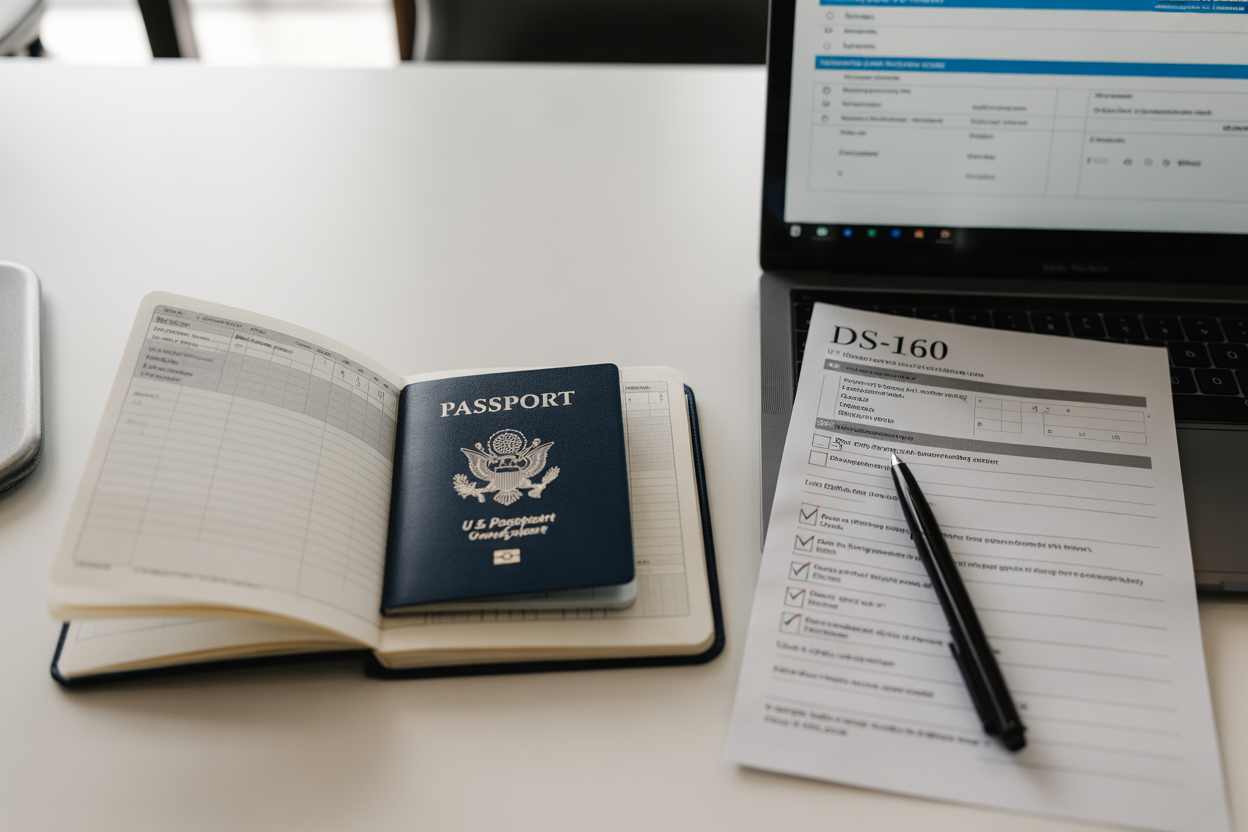
Preparing the full set of documents required for a U.S. visa application is one of the most decisive factors in achieving a successful outcome. A complete and organized checklist reduces errors, accelerates the review process, and ensures that each stage of the application—online submission, fee payment, interview scheduling, documentation review, and consular interview—can proceed without interruptions. According to the U.S. Department of State (2024), missing or inconsistent documentation is one of the most common causes of delays, rejections, and administrative processing under section 221(g). A structured approach offers clarity to applicants across all visa categories, both nonimmigrant and immigrant — see our B-1/B-2 visa guide for the tourist and business visa-specific process.
A general checklist must address requirements that apply universally to every applicant while also incorporating specialized documents needed for specific visa types such as tourist, business, student, work-based, exchange, or immigrant visas. This guide provides an extensive, detailed, and practical master checklist to support a seamless U.S. visa application process.
- Core Documents Required for All U.S. Visa Applicants
- Checklist for the Online Application Stage
- Checklist for Scheduling the Visa Interview
- Checklist of Required Documents for the Visa Interview
- Checklist by Visa Category
- Checklist for Administrative Processing and Additional Requests
- Checklist for the Post-Decision Stage
- Printable Master Checklist (PDF Ready)
- Expert Tips to Avoid Documentation Mistakes
Core Documents Required for All U.S. Visa Applicants
Every applicant—regardless of nationality, visa category, or purpose of travel—must prepare a standard set of documents. These form the backbone of the application and are mandatory at the online application stage, the scheduling stage, and the visa interview.
Valid Passport Requirements
A valid passport is the primary identity document in the U.S. visa process. The U.S. Department of State requires that passports remain valid for at least six months beyond the date of intended entry into the United States unless the applicant’s country participates in the Six-Month Club, which reduces this requirement. The passport must:
-
Be in good physical condition with no tears, water damage, or broken lamination.
-
Contain at least one blank page for the visa stamp.
-
Include all previously issued passports, as consulates often review travel history, past visas, and immigration compliance.
Countries with passports damaged or nearing expiration often encounter delays or mandatory renewals before interview attendance can be approved.
Digital Photograph Meeting U.S. Visa Photo Standards
The visa photograph must meet rigorous specifications. The State Department’s photo guidelines outline:
-
Size: 2 x 2 inches (51 x 51 mm)
-
White or off-white background
-
Neutral expression and direct camera view
-
No shadows, reflections, or filters
-
Proper resolution and JPEG quality
Errors in the photo upload frequently cause DS-160 or DS-260 rejections, forcing applicants to resubmit the form or bring corrective photos to the interview.
DS-160 or DS-260 Confirmation Page
Nonimmigrant visa applicants must complete the DS-160, while immigrant visa applicants must complete the DS-260. The confirmation page is mandatory at all stages of the process. It must be printed or saved digitally and must contain:
-
The applicant’s photo (if uploaded successfully)
-
The DS-160 or DS-260 barcode
-
The confirmation number associated with the applicant’s profile
Discrepancies between the DS form and the applicant’s physical documents often result in interview complications.
Visa Fee Payment Receipt (MRV Fee)
The Machine-Readable Visa (MRV) fee must be paid prior to scheduling the interview. Each applicant must retain:
-
Proof of successful payment
-
Transaction number
-
Applicant ID
-
Date of payment
Some visa categories require additional fees (SEVIS, petition fees, USCIS fees), which must be included in the complete checklist.
Checklist for the Online Application Stage
Completing the online portion is the foundation of the application. Errors here often cascade into all other stages.
Access Information for the Visa Application System
Applicants must gather:
-
A working email address
-
Passport information
-
Travel itinerary (if available)
-
U.S. contact information
-
Social media accounts used in the past five years, as required by U.S. security screening policies (2019 update)
Required Information to Complete DS-160 or DS-260
These forms require comprehensive information:
-
Full biographical data
-
Residential history
-
Employment and academic history
-
Prior visits to the United States
-
Details of prior visas, refusals, or overstays
-
Family information
-
Security and background questions
Providing truthful, consistent, and verifiable information is essential. According to the U.S. Government Accountability Office (2023), inconsistencies in DS forms are among the most common triggers for administrative processing.
Required Uploads and Attachments
The digital photograph must be uploaded, along with any supporting documents that the system may request depending on nationality, visa type, or security category. Applicants must verify compatibility with file size, dimensions, and formats before submission.
Checklist for Scheduling the Visa Interview
Once the DS form and MRV fee are completed, applicants must schedule their biometrics appointment and consular interview.
Appointment Scheduling Requirements
To schedule successfully, applicants must have:
-
DS-160 or DS-260 confirmation number
-
MRV payment receipt number
-
Passport number
-
Profile login credentials
Appointment Confirmation Documents
Applicants must print or download:
-
Biometrics appointment confirmation (VAC)
-
Consular interview appointment confirmation
-
Any additional notices provided by the system
Rescheduling notices must also be printed or saved, as consulates may require proof of modified appointments.
Checklist of Required Documents for the Visa Interview
Identity and Civil Documentation
-
Valid passport
-
Previous passports with U.S. or other visas
-
Birth certificate (if required for immigrant cases, minors, or family-based applications)
-
National ID card (if applicable)
Evidence of Financial Capacity
Consular officers evaluate financial stability and economic ties to the applicant’s home country. Supporting evidence may include:
-
Recent bank statements (usually 3–6 months)
-
Statements of income or employment contracts
-
Tax declarations
-
Business registration documents or financial summaries for entrepreneurs
-
Property deeds or vehicle ownership records
Proof of Ties to the Home Country
Demonstrating strong connections to the home country is essential for nonimmigrant visas. Supporting documents may include:
-
Employment letters with approval for leave
-
Academic enrollment certificates
-
Evidence of family ties
-
Mortgage or rental contracts
-
Utility bills or proof of residency
Travel Purpose Documentation
Consular officers must assess the legitimacy of the planned trip. Depending on the purpose, applicants may prepare:
-
Flight itineraries (not mandatory but useful)
-
Accommodation reservations
-
Conference registrations
-
Letters of invitation
-
Employer travel assignment letters
Background and Security Documents
-
Police certificates (mandatory for many immigrant visas and some exchange visas)
-
Military records (if applicable)
-
Court documents for previous legal issues
-
Translations of foreign documents when required
Checklist by Visa Category
Each visa category imposes additional requirements.
Tourist and Business Visas (B1/B2)
-
Complete travel purpose outline
-
Evidence of tourism or business agenda
-
Proof of solvency
-
Employer or school confirmation letters
-
Prior travel history documentation
The consular officer must determine the likelihood of returning home; therefore, economic, family, and social ties are critical.
Student Visas (F-1/M-1)
-
Form I-20 issued by the U.S. educational institution
-
SEVIS I-901 fee payment receipt
-
Admission letter
-
Academic transcripts
-
Standardized test results (if applicable)
-
Proof of funds sufficient for one full academic year, per regulations of the Department of Homeland Security
Exchange Visitor Visas (J-1)
-
Form DS-2019
-
SEVIS I-901 fee payment
-
Proof of insurance meeting J-1 minimum coverage requirements
-
Sponsor letter
-
Evidence of ties to home country
Work Visas (H-1B, L-1, O-1, etc.)
-
I-797 petition approval from USCIS
-
Employer support letter outlining position and salary
-
Labor Condition Application (H-1B)
-
Corporate documentation for L-1 transfers
-
Evidence of extraordinary ability for O-1 applicants (awards, publications, professional distinctions)
Immigrant Visas (Family, Employment, Diversity)
-
DS-260 confirmation
-
Police certificates
-
Medical examination results (sealed envelope if required)
-
Civil documents: birth certificates, marriage certificates, divorce decrees
-
Affidavit of Support (Form I-864)
-
Financial supporting documentation from the sponsor
-
Federal tax returns (per USCIS guidelines)
Checklist for Administrative Processing and Additional Requests
Form 221(g) Documentation
If the consular officer issues a 221(g) request, applicants may need — see our complete guide to administrative processing for what to expect and how long it takes:
-
Updated civil documents
-
Employer verification
-
Additional financial proof
-
More detailed travel purpose explanations
-
Missing translations
-
Passports for visa issuance
Timely response is essential, as delays may result in long wait times.
Additional Security and Background Checks
Some applicants must provide:
-
Extended travel histories
-
Social media identifiers
-
Military service details
-
Publications or research summaries (common for STEM applicants)
This aligns with increased screening measures implemented in recent years.
Checklist for the Post-Decision Stage
If Visa Is Approved
Applicants should prepare to:
-
Retrieve the passport from the designated pickup location
-
Verify the printed visa information (name, date of birth, visa class)
-
Confirm entry rules and expiration dates
-
Maintain all supporting documents for future travel
If Visa Is Denied
A denial notice does not end eligibility permanently. Applicants should:
-
Review the refusal section (214(b), 221(g), or others)
-
Identify weak points in the documentation
-
Strengthen ties, financial stability, or supporting evidence
-
Prepare for a future reapplication
Printable Master Checklist (PDF Ready)
A proper master checklist typically includes:
General Documents
-
Passport (valid)
-
Previous passports
-
DS-160 or DS-260 confirmation
-
MRV receipt
-
Visa photo
-
Appointment confirmations
Online Application Stage
-
Email access
-
Digital photo
-
Required biographical, employment, and travel data
Interview Stage
-
Identity documents
-
Financial evidence
-
Proof of home-country ties
-
Purpose-of-travel documentation
-
Specialized visa documents
This structured approach enables applicants to track progress and reduce mistakes.
Expert Tips to Avoid Documentation Mistakes
-
Ensure consistency across all documents and DS forms.
-
Avoid handwritten alterations in official documents.
-
Use certified translations when needed.
-
Bring originals and copies of key documents.
-
Maintain chronological coherence in travel and employment histories.
-
Avoid overloading the officer with unnecessary documents—prioritize relevance.
According to the Migration Policy Institute (2023), applicants who demonstrate clarity, organization, and relevance during the interview experience significantly higher approval rates.
