

The F-1 student visa interview is a legal eligibility assessment, not a test of confidence, clothing or memorized answers. The consular officer uses Form DS-160, Form I-20, government records, the interview and any relevant documents to decide whether the applicant qualifies for temporary academic study in the United States.
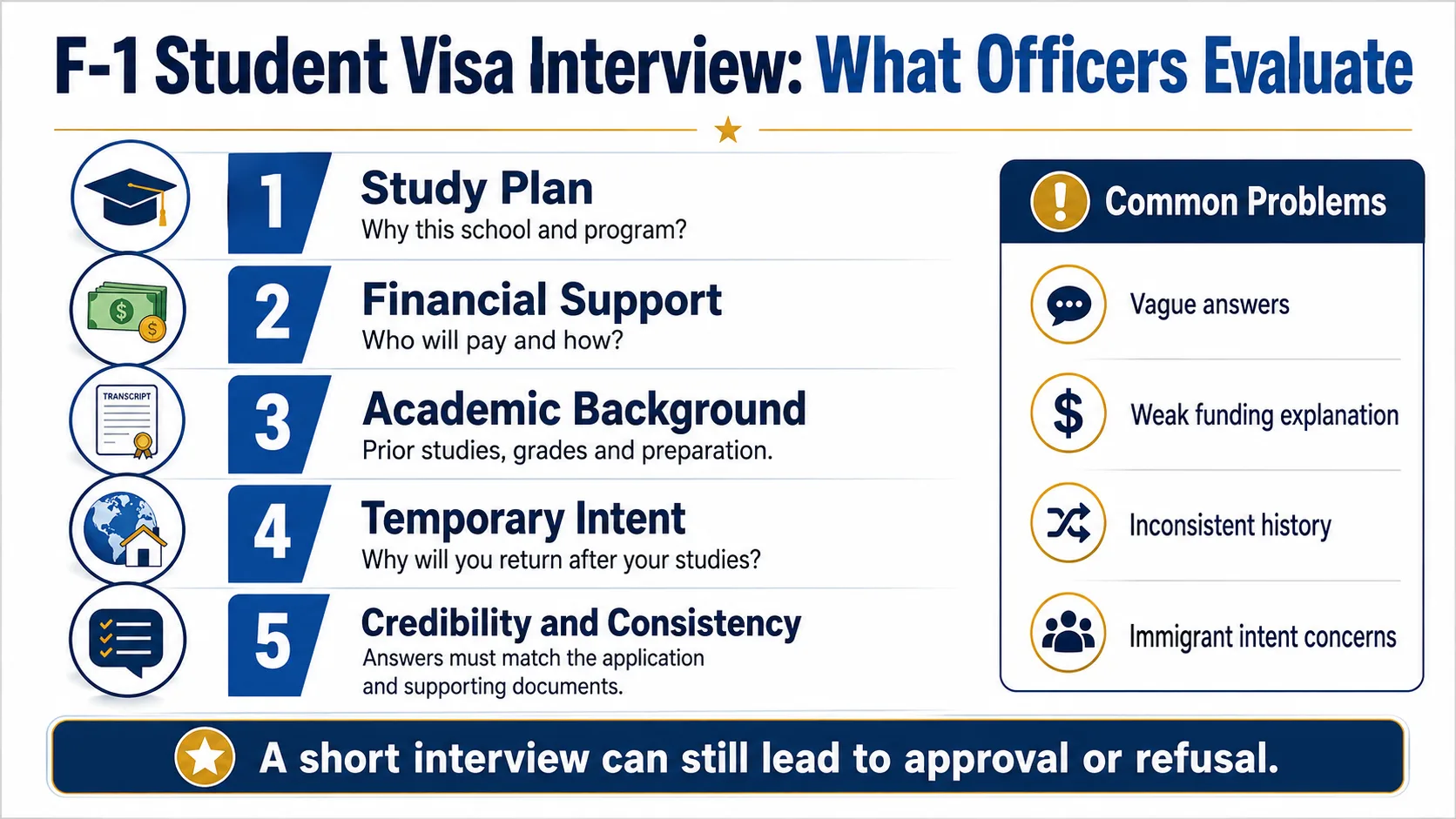
The officer normally evaluates four central questions:
- Is the applicant a genuine student with a credible academic purpose?
- Is the selected school and program consistent with the applicant’s background and goals?
- Is the funding sufficient and believable?
- Does the applicant intend to comply with temporary F-1 status and remain otherwise admissible?
A short interview can still involve a complete legal decision. Applicants should not assume that an officer failed to consider the case simply because every document was not reviewed.
- What the F-1 Interview Is Designed to Determine
- Before the Interview
- Question Category 1: School and Program Choice
- Question Category 2: Academic Background
- Question Category 3: Financial Support
- Question Category 4: Plans After Graduation
- Question Category 5: Family and Ties
- Question Category 6: Prior Travel and Immigration History
- Section 214(b) and Student Visas
- Section 221(g) and Administrative Processing
- Fraud and Misrepresentation Risks
- How to Answer Effectively
- Interview Myths
- Special Issues in 2026
- After the Interview
- Related Student Visa Guides
What the F-1 Interview Is Designed to Determine
The Department of State requires an F-1 applicant to establish eligibility for the student classification. School admission and Form I-20 are necessary, but the consular officer independently evaluates the visa application.
Official student visa guidance: travel.state.gov
The interview is used to assess:
Identity and security — The officer confirms the applicant’s identity, passport, biographical information, immigration history and security answers.
Academic purpose — The officer determines whether the applicant intends to pursue the program listed on Form I-20 and understands the educational plan.
Financial ability — The applicant must show a credible ability to pay tuition and living expenses without unauthorized employment.
Nonimmigrant intent — Under Section 214(b), the applicant must establish eligibility for temporary student status
and a present intention to comply with the classification.
Admissibility — Prior overstays, unauthorized employment, criminal issues, fraud, misrepresentation, removal orders or other statutory grounds can affect issuance.
Before the Interview
A strong interview begins with an accurate record.
Review Form DS-160, Form I-20, school admission letter, program name, degree level and start date, tuition and living-cost estimates, funding sources, prior education and employment history, U.S. relatives and contacts, and prior visa applications and travel.
The applicant should correct genuine errors through the process permitted by the embassy or consulate. Attempting to hide an inconsistency creates a larger problem.
The appointment profile should contain the correct DS-160 confirmation number. The passport and Form I-20 should match. The I-901 SEVIS fee should be paid under the correct SEVIS identification number.
Documents to Bring
Core documents generally include a valid passport, DS-160 confirmation page, appointment confirmation, Form I-20 signed by the DSO and student, I-901 SEVIS fee receipt, visa fee receipt if required locally, and a printed photograph if the DS-160 upload failed.
Supporting evidence can include school acceptance correspondence, transcripts and diplomas, standardized test results, scholarship or assistantship letters, bank statements, sponsor income and tax records, educational loan approval, employment or business records, and evidence explaining an academic gap or career change.
Documents should support the same story as Form DS-160 and Form I-20.
A large folder cannot overcome an implausible academic or financial plan.
Question Category 1: School and Program Choice
Why did you choose this university?
A useful answer identifies program-specific features such as curriculum, specialization, laboratory resources, faculty, clinical training, accreditation, industry partnerships or research opportunities.
Weak answer: “It is the best university and my agent recommended it.”
Stronger approach: “I selected the master’s program because it combines supply-chain analytics with coursework in operations research. That specialization directly builds on my industrial engineering degree and my current logistics role.”
Why not study this program in your home country?
The applicant should avoid insulting domestic institutions. The answer can explain a specialized curriculum, technology, research method, professional network or degree structure not available in the same form at home.
Which other schools admitted you?
Answer truthfully. The officer may want to understand the selection process and whether the chosen school is academically and financially rational.
What will you study?
The applicant should know the degree, major, duration and principal subjects. A student who cannot describe the program may appear to be using enrollment for another purpose.
Why did you choose a lower-ranked or less expensive school?
Rank is not the only legitimate factor. Cost, location, faculty, program structure, scholarships, class size and specialization can explain the choice.
Question Category 2: Academic Background
What did you study before? The answer should match transcripts, résumé and DS-160.
Why are you changing fields? A field change can be credible when the applicant explains the connection. For example, a finance graduate entering business analytics may describe the need for statistical and technical skills.
Why is there a gap in your education? Employment, family responsibilities, military service, health, exam preparation or other genuine reasons can explain a gap. The applicant should not invent a history.
Why are your grades low? Acknowledge the issue and provide relevant context without blaming every teacher. The school’s admission does not prevent the officer from evaluating whether the plan is genuine.
Why are you pursuing another degree at the same level? Repeated degrees can receive scrutiny. The applicant should explain the distinct specialization and why it is necessary. Under the published final rule, if it later becomes operative, certain changes to the same or lower educational level after entry would face additional restrictions.
Question Category 3: Financial Support
Who will pay for your education? Identify every source clearly. If parents are sponsoring, explain their occupation, income and relationship. If funding combines a scholarship, savings and loan, state the amounts consistently with Form I-20.
What does your sponsor do? The officer may compare sponsor income with the cost of the program and other obligations.
How much does the program cost? Know the estimated tuition and living expenses shown on Form I-20. The student does not need to recite every fee, but should understand the financial commitment.
Why was a large amount recently deposited? Explain the source with evidence. It may represent a property sale, fixed-deposit maturity, educational loan or transfer from a documented sponsor. Unexplained temporary deposits can undermine credibility.
Will you work in the United States to pay tuition? The correct answer must reflect the actual plan and the law. F-1 employment is limited. On-campus employment, CPT and OPT cannot be treated as unrestricted funding for the entire degree.
Does a sponsor affidavit guarantee approval? No. The officer evaluates whether the funds are real, available and sufficient. A letter without supporting financial capacity is weak.
Question Category 4: Plans After Graduation
What will you do after graduation? The applicant should describe a realistic professional plan. It can include using the degree in the home country or another lawful location. The answer should not be a rehearsed promise unsupported by the applicant’s background.
Do you plan to use OPT? F-1 law permits eligible practical training. Truthfully acknowledging possible OPT does not automatically establish immigrant intent. The applicant should explain that any employment will follow authorization and remain connected to the degree.
Do you plan to apply for H-1B or a green card? The applicant should not lie about future possibilities. At the time of the F-1 application, the relevant issue is present intent. A response can explain that the immediate purpose is study and that any future application would occur only if separately eligible and lawful.
Do you have a job waiting at home? A genuine offer can support a career plan, but a fabricated letter creates risk. A student can qualify without a prearranged job.
Question Category 5: Family and Ties
Do you have relatives in the United States? Disclose them consistently with Form DS-160. A U.S. relative does not automatically cause refusal, but concealment can create credibility or misrepresentation concerns.
Where do your parents, spouse or children live? The officer may consider family circumstances as part of temporary intent and funding.
Is your spouse accompanying you? An F-2 spouse and children require separate applications and Forms I-20. F-2 dependents cannot work.
Do you own property? Property is one possible tie, not a mandatory requirement. Young students often qualify without it.
Question Category 6: Prior Travel and Immigration History
Have you visited the United States before? Answer consistently with passport stamps and government records.
Were you ever refused a visa? Prior refusals must be disclosed. Explain the legal section and what has materially changed if reapplying.
Did you ever overstay or work without authorization? These facts can affect eligibility and may require legal analysis. Concealing them is dangerous.
Were you previously in F-1 status? The officer may review SEVIS history, transfers, employment, completion and departure. A terminated record or repeated program changes can require explanation.
Section 214(b) and Student Visas
Section 214(b) applies to F-1 applicants. A refusal can mean that the applicant did not establish eligibility for the classification, did not overcome the presumption of immigrant intent, or both.
The officer evaluates the complete circumstances. No universal list of “strong ties” guarantees approval.
A 214(b) refusal is a decision on the current application, has no formal appeal, does not have a mandatory waiting period before reapplication, requires a new DS-160 and fee, and often produces the same result when nothing material changes.
A refusal is not automatically proof that the applicant lied. It means the legal standard was not met to the officer’s satisfaction.
Section 221(g) and Administrative Processing
Section 221(g) can apply when a required document is missing, additional information is requested, the case requires administrative processing, or a security or technical review remains pending.
CEAC may show Refused during this period. The applicant should follow the written instructions and avoid submitting unrelated documents unless requested.
Administrative processing has no universal completion time. The embassy may be unable to provide detailed reasons while checks continue.
Fraud and Misrepresentation Risks
False statements can create consequences beyond an ordinary denial. Examples include fake bank statements, false employment or property letters, invented academic records, concealed relatives or refusals, misstating the school or program, claiming funds belong to the applicant when they were temporarily borrowed, and presenting a fabricated home-country job offer.
A willful material misrepresentation can create permanent inadmissibility. Applicants should correct mistakes honestly rather than build additional false statements around them.
How to Answer Effectively
Be direct. Answer the question asked. A long speech can introduce inconsistencies.
Be specific. Identify the program, funding source or career objective rather than using generic language.
Be truthful. Do not use a script that conflicts with the actual record.
Be calm. Nervousness is normal and does not itself establish ineligibility.
Use documents when relevant. Offer the document that supports the answer, but understand that the officer may not review it.
Do not argue. If the officer reaches a decision, remain respectful and read the refusal notice carefully.
Interview Myths
Myth: Expensive clothing improves approval chances. Reality: Eligibility and credibility matter. Neat, practical clothing is sufficient.
Myth: Every answer should be one sentence. Reality: Answers should be concise but complete enough to address the question.
Myth: Mentioning OPT guarantees refusal. Reality: OPT is a lawful F-1 benefit. The problem is presenting employment or permanent residence as the principal purpose of the visa.
Myth: An invitation from a U.S. relative guarantees approval. Reality: The applicant must independently qualify for F-1.
Myth: A high bank balance is the most important factor. Reality: The officer evaluates the source, availability and relationship of funds to the educational plan.
Myth: A previous refusal must be hidden. Reality: Refusals are visible in government records and must be disclosed.
Special Issues in 2026
Nationality-based restrictions — Current visa-issuance suspensions affect some F, M and J applicants, subject to exceptions. School admission does not override a proclamation. Applicants should check the Department of State Visa News page before paying or attending.
Social-media and security review — Form DS-160 requests specified social-media identifiers. Applicants should answer accurately. Publicly available information that conflicts with the application can create questions. Deleting or falsifying information to conceal a material fact can be more damaging than the original content.
Current rule status — DHS published its fixed-admission final rule in July 2026, but a federal court postponed implementation before the planned September 15 effective date. Duration of Status remains in effect while the case continues. The visa interview remains focused on eligibility, and applicants should understand that D/S continues to be the operative admission framework for now.
Official rule: federalregister.gov
After the Interview
Approved — The passport is generally retained for visa printing. Approval is not the same as final issuance.
Issued — The visa has been finalized for delivery. Review all biographical details when the passport returns.
214(b) — Determine what part of the record failed to establish eligibility. Reapply only with a realistic strategy and accurate information.
221(g) — Follow the document or administrative-processing instructions.
Other inadmissibility — A criminal, fraud, unlawful-presence or removal issue may require a waiver or may not be waivable. Obtain legal advice.
Related Student Visa Guides
- Student Visa Guide Center
- F-1 Complete Guide
- F-1 Requirements
- F-1 Application Process
- F-1 Denial Reasons
- CEAC Visa Status
- Appointment Wait Times
The goal of general U.S. visa interview preparation is not to manufacture a perfect performance. It is to ensure that the applicant understands the program, can explain the funding and presents a record that is truthful, coherent and legally compatible with temporary F-1 study.
