

The H-1B visa is the United States’ primary work visa for foreign nationals employed in specialty occupations. Every year, hundreds of thousands of skilled professionals from around the world seek this visa to work for American employers in fields like technology, engineering, medicine, finance, and architecture. This comprehensive guide covers everything you need to know about the H-1B visa in 2026, from eligibility requirements and the annual lottery to the long road toward permanent residency.
Last updated: August 4, 2026.
- 1. What Is the H-1B Visa?
- 2. Who Qualifies for an H-1B Visa?
- 3. The H-1B Cap: Understanding the Annual Numerical Limit
- 4. The H-1B Lottery: Electronic Registration System
- Proposed H-1B Wage Changes: What Employers Need to Know (2026 NPRM)
- 5. How to Apply for an H-1B Visa: Step-by-Step Process
- 6. H-1B Fees: A Complete Breakdown
- 7. H-1B Duration and Extensions
- 8. H-1B to Green Card: The Permanent Residency Path
- 9. H-1B Transfers and Portability
- 10. H-4 Dependent Visa and H-4 EAD
- 11. Cap-Gap Protection for F-1 OPT Students
- 12. Common H-1B Denial Reasons and RFE Responses
- 13. H-1B Alternatives If Not Selected in the Lottery
- 14. Top H-1B Sponsoring Employers (2025)
- 15. USCIS Processing Times for H-1B Petitions (2026)
- 16. Frequently Asked Questions About the H-1B Visa
- Can I apply for an H-1B without a job offer?
- What is the H-1B lottery selection rate in 2025?
- Can I change jobs while on an H-1B?
- How long does it take to get a green card from H-1B?
- Can my spouse work on an H-4 visa?
- Is the H-1B visa being eliminated in 2026?
- What happens if I am not selected in the H-1B lottery?
- Latest Updates & Related Guides
- Related Work Visa and Green Card Guides
1. What Is the H-1B Visa?
The H-1B is a nonimmigrant visa classification that allows U.S. employers to temporarily employ foreign workers in specialty occupations. Its legal basis is found in the Immigration and Nationality Act (INA) § 101(a)(15)(H), which defines the H classification of nonimmigrant workers. The H-1B subcategory specifically covers workers in “specialty occupations,” a term that carries precise legal meaning under U.S. immigration law.
Under INA § 214(i)(1), a specialty occupation is defined as one that requires the theoretical and practical application of a body of highly specialized knowledge, and that requires attainment of a bachelor’s or higher degree in the specific specialty (or its equivalent) as a minimum for entry into the occupation in the United States. In practical terms, this means the job must normally require at least a four-year college degree in a related field.
The H-1B classification is governed by 8 CFR § 214.2(h) and administered by U.S. Citizenship and Immigration Services (USCIS). The visa itself — the stamp in a passport — is issued by the U.S. Department of State at consulates abroad, but the underlying immigration benefit (the approved petition) is granted by USCIS.
Common H-1B specialty occupations include software engineers and developers, data scientists, financial analysts, physicians and surgeons, university professors and researchers, architects and civil engineers, accountants and auditors, lawyers and legal professionals, and management consultants. The H-1B is employer-sponsored, meaning you cannot self-petition — a U.S. employer must file the petition on your behalf.
2. Who Qualifies for an H-1B Visa?
Specialty Occupation Requirement
To qualify as a specialty occupation under USCIS regulations, the position must meet one of four criteria: (1) a baccalaureate or higher degree or its equivalent is normally the minimum requirement for entry into the particular position; (2) the degree requirement is common to the industry in parallel positions among similar organizations; (3) the employer normally requires a degree or its equivalent for the position; or (4) the nature of the specific duties is so specialized and complex that the knowledge required to perform them is usually associated with a bachelor’s or higher degree.
The beneficiary (the foreign worker) must also possess the required degree or its equivalent. USCIS will evaluate whether your educational credentials and work experience are sufficient. Three years of progressive work experience is generally considered equivalent to one year of college education, meaning 12 years of relevant experience can substitute for a four-year degree — though this equivalency is more scrutinized today than in prior years.
Employer-Employee Relationship
USCIS requires a valid employer-employee relationship between the petitioning company and the H-1B worker. The employer must have the right to control the work of the employee — including the ability to hire, fire, pay, supervise, and otherwise control the work. This has become a significant issue for consulting companies that place workers at third-party client sites. USCIS scrutinizes “itinerary” cases where the work location or specific duties are not clearly defined at the time of filing.
Self-employed individuals generally cannot petition for themselves unless they can demonstrate that a separate legal entity (such as a corporation) controls their work. A foreign national who owns a business may qualify if the business has a board of directors or other structure that maintains the right to control the worker’s employment.
Labor Condition Application (LCA)
Before filing an H-1B petition with USCIS, the employer must obtain a certified Labor Condition Application (LCA) from the U.S. Department of Labor (DOL). The LCA is filed electronically through the DOL’s FLAG system and is typically certified within seven business days.
By filing the LCA, the employer makes four attestations: (1) the employer will pay the H-1B worker the required wage, which is the higher of the actual wage paid to similarly employed workers or the prevailing wage for the occupation in the geographic area; (2) the employment of the H-1B worker will not adversely affect the working conditions of U.S. workers similarly employed; (3) there is no strike, lockout, or work stoppage in the course of a labor dispute in the occupational classification at the place of employment; and (4) notice of the LCA filing has been provided to existing workers in the occupational classification at the place of employment.
The prevailing wage is determined by reference to the DOL’s Online Wage Library, the Occupational Employment and Wage Statistics (OEWS) survey, or a private wage survey. There are four wage levels (Level I through Level IV), with Level I being the lowest and Level IV being the highest. USCIS has scrutinized Level I and Level II wage designations in recent years, particularly for entry-level positions that some argue do not reflect the true specialty nature of the work.
3. The H-1B Cap: Understanding the Annual Numerical Limit
Congress has set a statutory cap on the number of new H-1B visas that can be issued each fiscal year. The current annual cap structure is as follows:
- Regular cap: 65,000 H-1B visas per fiscal year
- U.S. Master’s exemption (advanced degree exemption): an additional 20,000 visas for beneficiaries who have earned a U.S. master’s degree or higher
- Total: 85,000 H-1B cap-subject visas per year
The 65,000 regular cap was established by the Immigration Act of 1990 and has remained unchanged despite dramatically increased demand. Of the 65,000 regular cap numbers, 6,800 are reserved for nationals of Chile and Singapore under the respective free trade agreements (H-1B1 visa category). The 20,000 master’s cap exemption was added by the H-1B Visa Reform Act of 2004.
Cap-Exempt Employers
Certain employers and employment situations are entirely exempt from the H-1B annual cap, meaning they can file H-1B petitions at any time of year without waiting for the lottery:
- Institutions of higher education (as defined in the Higher Education Act of 1965), including four-year colleges and universities
- Nonprofit organizations or entities related to or affiliated with an institution of higher education
- Nonprofit research organizations (organizations primarily engaged in research or education)
- Government research organizations, including national laboratories like NIH, CDC, and Department of Energy labs
A worker previously counted against the cap retains their cap-counted status for the purpose of future extensions, transfers, and amendments — even when moving to a cap-exempt employer. Additionally, if you have previously been counted against the H-1B cap within the prior six years and still have time remaining on your H-1B, you do not need to go through the lottery again when changing employers or extending your status.
4. The H-1B Lottery: Electronic Registration System
Since fiscal year 2021, USCIS has used an electronic pre-registration system to manage H-1B cap demand. The previous system required employers to submit full petition packages before USCIS would conduct the lottery, which was expensive and burdensome. The current system works as follows:
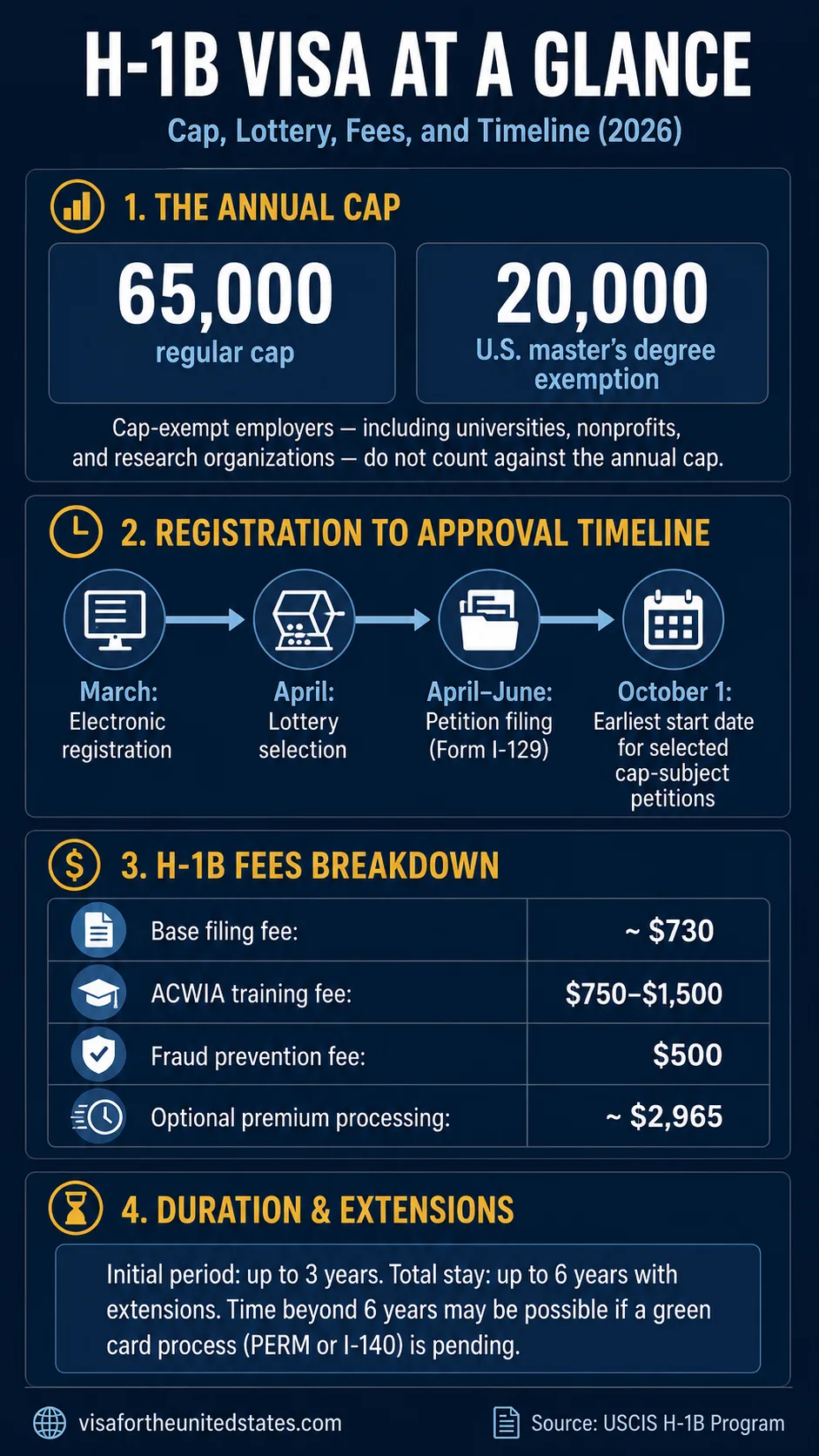
H-1B Lottery annual timeline and cap numbers. FY 2027 registration opens March 2026.
Step 1: Electronic Registration (March)
Each year, USCIS opens the electronic registration window for approximately two weeks in early March (the exact dates are announced each year). Employers (or their attorneys) log into the myUSCIS portal and submit a brief registration for each prospective H-1B worker. The registration includes basic information about the employer and the beneficiary and requires payment of a $215 registration fee per beneficiary (unchanged for FY2027 as of this update). No full petition documents are required at this stage.
Step 2: Lottery Selection
After the registration window closes, USCIS conducts the lottery. The selection process gives master’s degree holders two chances: first, all registrations compete in the 65,000 regular cap lottery; then, any unselected registrations from U.S. master’s holders compete again in the 20,000 advanced degree exemption lottery. Selected registrants are notified through their myUSCIS accounts, typically by late March.
Beginning with the FY2027 registration cycle, USCIS applies a weighted selection process under the DHS final rule “Weighted Selection Process for Registrants and Petitioners Seeking To File Cap-Subject H-1B Petitions,” 90 FR 60864, published December 29, 2025, and effective February 27, 2026. Registrations are weighted according to the beneficiary’s equivalent OEWS wage level, while selection continues to include a randomized component. Applicants and employers should verify the rules announced by USCIS for each future registration cycle.
In recent years, demand has far exceeded supply. For FY2025, USCIS received approximately 470,000 registrations for 85,000 available slots. The odds of selection have ranged from roughly 14% to 27% depending on the year and whether the registrant holds a U.S. master’s degree. USCIS has the authority to conduct additional lottery rounds (second lottery, third lottery) if the initial selection does not yield enough approvable petitions.
Starting with FY2025 registrations, USCIS implemented a beneficiary-centric selection model, where each unique beneficiary (identified by passport number and date of birth) is entered into the lottery once, regardless of how many employers register them. This change was made to address the problem of large staffing companies submitting multiple registrations for the same worker to game the odds.
Step 3: Petition Filing (April 1 Start)
Selected registrants have a 90-day window to file the full H-1B petition (Form I-129) with USCIS. For a fiscal year beginning October 1, this filing window typically opens April 1. Petitions may not be filed before April 1 for cap-subject cases.
Step 4: October 1 Employment Start Date
The earliest date a cap-subject H-1B worker can begin employment is October 1 of the new fiscal year. Workers currently in the United States in another valid status (such as F-1 OPT or another work visa) may be able to change status and begin working as H-1B employees on October 1. Workers abroad must obtain an H-1B visa stamp from a U.S. consulate before entering the country to work.
⚠️ H-1B 2026 Legislative Alert
The End H-1B Visa Abuse Act (introduced May 2026 by Rep. Eli Crane) would impose a 3-year freeze on new H-1B cap-subject petitions and require a $200,000 minimum wage for all H-1B positions. Extensions and transfers of existing H-1B status would NOT be affected.
The bill has not passed Congress. Full analysis →
Status: Introduced — not voted on as of May 2026. Monitor for updates.
H-1B Lottery Historical Odds (FY2020–FY2026)
Demand for H-1B visas has grown dramatically over the past decade. The table below shows how lottery odds have shifted and why winning the lottery has become increasingly competitive:
Proposed H-1B Wage Changes: What Employers Need to Know (2026 NPRM)
On March 27, 2026, the Department of Labor published a proposed rule (NPRM) that would significantly raise the minimum wages employers must pay H-1B workers. The comment period closed May 26, 2026. Under the proposal, Level I (entry-level) wages would shift from the 17th to the 34th percentile of OEWS wage data — roughly doubling the statistical floor. This translates to salary increases of 20–30% in most metro areas for entry-level tech workers.
The DOL estimates that more than 75% of currently certified LCA positions would fall below the proposed new floors. The rule is not yet finalized. If adopted, it could take effect in late 2026 or 2027. For full details, salary estimates by city, and a timeline of next steps, see: H-1B Salary Increase 2026: DOL NPRM Explained.
Visa Integrity Fee. Public Law 119-21 created a separate fee tied to the issuance of a nonimmigrant visa and established a statutory minimum for fiscal year 2025. It is not a Form I-129 filing fee. Complete official instructions confirming the currently collectible amount, collection procedure, and reimbursement process have not been published by the Department of State and DHS. Applicants should review the current Department of State fee schedule and any subsequent DOS or DHS implementation guidance rather than adding this amount to an H-1B petition filing calculation.
| Fiscal Year | Registrations / Petitions | Slots Available | Overall Odds | Notes |
|---|---|---|---|---|
| FY2020 | 201,011 | 85,000 | ~42% | Pre-electronic registration; full petitions filed |
| FY2021 | 274,237 | 85,000 | ~31% | First year of electronic registration ($10 fee) |
| FY2022 | 308,613 | 131,970* | ~43%* | 3 selection rounds; higher odds due to multiple rounds |
| FY2023 | 483,927 | 127,600 | ~26% | Multiple rounds; demand surge post-COVID |
| FY2024 | 758,994 | 110,791 | ~15% | Record registrations; USCIS found duplicate abuse |
| FY2025 | ~442,000 | ~85,000 | ~19% | Beneficiary-centric model eliminated duplicate abuse |
| FY2026 | ~470,000 | ~85,000 | ~18% | Registration fee raised to $215; 1 entry per beneficiary |
*FY2022 conducted 3 rounds of selection. Sources: USCIS official data releases.
5. How to Apply for an H-1B Visa: Step-by-Step Process
Step 1: Employer Files the LCA with DOL
The process begins well before any petition is filed with USCIS. The employer (or their attorney) must prepare and file the LCA through the DOL’s FLAG system. The LCA specifies the job title, SOC code, wage level, prevailing wage, actual wage, and worksite location(s). DOL typically certifies the LCA within seven business days. The employer must also post public notice of the LCA at the worksite for ten consecutive business days.
Step 2: Employer Files Form I-129 with USCIS
Once the LCA is certified, the employer prepares and files Form I-129 (Petition for Nonimmigrant Worker) with the appropriate USCIS service center. The petition package includes the certified LCA, evidence of the specialty occupation nature of the position, evidence of the beneficiary’s qualifications (degree transcripts, diplomas, foreign credential evaluations), evidence of the employer-employee relationship, and the required fees.
Supporting documentation typically includes a detailed job description, organizational charts showing where the position fits in the company, the employer’s financial records (tax returns, annual reports), offer letter or employment agreement, and any itinerary of services if the worker will be placed at third-party client sites.
Step 3: USCIS Adjudication
USCIS reviews the petition and may issue a Request for Evidence (RFE) seeking additional information or documentation. If the petition is approved, USCIS issues Form I-797 (Notice of Action) reflecting the approved status. Standard processing times have varied from a few months to over a year; premium processing is available to get a decision within 15 business days (see fees below).
Step 4: Visa Stamp at the U.S. Consulate (If Abroad)
If the beneficiary is outside the United States when the petition is approved (or needs to travel abroad), they must obtain an H-1B visa stamp at a U.S. Embassy or Consulate. This involves scheduling a visa appointment through the consular electronic appointment system, completing the DS-160 online application, Applicants applying for an H-1B visa at a U.S. consulate must also pay the applicable MRV visa application fee. The Department of State currently lists a $205 fee for petition-based H categories. Verify the amount on the official fee schedule before the interview. Attending the visa interview and providing biometrics are also required.
The visa stamp is separate from the approved petition. The petition defines your immigration status in the U.S., while the visa stamp is the travel document that allows you to seek entry at a port of entry. H-1B visa stamps can be obtained in the applicant’s home country or, in some cases, in a third country (third-country national processing).
Step 5: Entry into the United States
Upon arriving at a U.S. port of entry, the H-1B holder presents their passport (with the valid H-1B visa stamp), Form I-797 approval notice, and other supporting documents to a Customs and Border Protection (CBP) officer. CBP will admit the worker and annotate their admission record in the I-94 system. The I-94 reflects the period of authorized stay, which should match the petition approval period.
6. H-1B Fees: A Complete Breakdown
Filing an H-1B petition involves several mandatory fees and optional fees. Employers are required to pay most of these fees; charging certain fees to the employee is prohibited.
Base Filing Fee
The base Form I-129 filing fee varies according to the filing category, filing method, and whether the petitioner qualifies as a small employer or nonprofit. Additional charges may also apply. Confirm every required payment using the current USCIS Form G-1055 and Fee Calculator immediately before filing.
ACWIA Training Fee
The American Competitiveness and Workforce Improvement Act (ACWIA) training fee funds workforce training programs. The amount depends on employer size:
- $750 for employers with 1 to 25 full-time equivalent employees
- $1,500 for employers with 26 or more full-time equivalent employees
This fee is exempt for cap-exempt employers (universities, nonprofits, government research organizations) and does not apply to extensions with the same employer.
Fraud Prevention and Detection Fee
A $500 fraud prevention and detection fee is required for initial H-1B petitions and when an H-1B worker changes employers. It is not required for extensions with the same employer.
Asylum Program Fee
As of April 2024, a new $600 Asylum Program Fee applies to most employers filing I-129 petitions. Nonprofit organizations are exempt; small employers (25 or fewer employees) pay a reduced $300 fee.
Premium Processing Fee (Optional)
Premium processing is an optional service that guarantees USCIS will take action on the petition within 15 business days. The current premium processing fee for Form I-129 is $2,965 (increased from $2,805, effective for filings postmarked on or after March 1, 2026). This fee can be paid by either the employer or the employee (it is one of the few H-1B fees the employee may legally pay). “Action” means USCIS will approve, deny, or issue an RFE — it does not guarantee approval.
H-1B1 FTA Fee
An additional $4,000 fee (commonly called the “Grassley-Sanders fee”) applies to petitions filed by H-1B-dependent employers (those whose workforce is more than 15% H-1B workers) who are not hiring U.S. workers. This does not apply to most mainstream employers.
Total Estimated Fees
USCIS fees for an initial H-1B petition may include the applicable Form I-129 filing fee, the ACWIA fee, the Fraud Prevention and Detection Fee, the Asylum Program Fee, and optional premium processing, depending on the petitioner and filing. Other statutory or program-specific charges may also apply. Calculate the total using the current USCIS Form G-1055 and Fee Calculator immediately before filing. These fees must be paid by the employer (except premium processing and the visa application fee).
7. H-1B Duration and Extensions
The H-1B visa is granted in increments tied to the employment relationship and, ultimately, to your green card progress.
Initial Period: 3 Years
An initial H-1B approval is generally granted for three years, with a maximum validity period tied to the LCA end date. Extensions can be granted for additional periods of up to three years each.
Maximum 6-Year Period
The statutory maximum for H-1B status is six years (initial three years plus one three-year extension). After six years, the foreign national must generally leave the United States for one year before becoming eligible for another H-1B, unless an exception applies.
Extensions Beyond Six Years Under AC21
The American Competitiveness in the Twenty-First Century Act (AC21) created two important exceptions that allow H-1B workers to extend their status beyond the six-year cap:
- AC21 § 106(a)/(b) — One-year extensions: If the applicable labor certification or immigrant petition was filed at least 365 days before the requested H-1B extension period begins, an eligible beneficiary may receive extensions in one-year increments while the statutory requirements continue to be met.
- AC21 § 104(c) — Extensions of up to three years: Certain beneficiaries of approved employment-based immigrant petitions who cannot obtain permanent residence because an immigrant visa number is unavailable may receive H-1B extensions in increments of up to three years while the qualifying visa-unavailability condition continues.
These provisions are critical for workers from India and China, where green card backlogs can span decades. Many H-1B workers from these countries remain in H-1B status for 15, 20, or even 30 years while waiting for their priority date to become current.
8. H-1B to Green Card: The Permanent Residency Path
The H-1B is an explicitly dual-intent visa, meaning you can hold H-1B status while simultaneously pursuing permanent residency (a green card) without it being considered an abandonment of nonimmigrant intent. This is one of the most important features of the H-1B compared to many other nonimmigrant visa categories.
Employment-Based Green Card Categories
Most H-1B workers pursue a green card through the employment-based (EB) preference system, primarily through the EB-2 (advanced degree or exceptional ability) or EB-3 (skilled workers and professionals) categories. The process typically involves three major stages:
Stage 1: PERM Labor Certification
The Program Electronic Review Management (PERM) process is a Department of Labor requirement for most EB-2 and EB-3 green card cases. PERM requires the employer to conduct a supervised job recruitment process to demonstrate that there are no qualified U.S. workers available for the position before hiring the foreign national permanently. The employer must advertise the position through specific channels (Sunday newspaper ads, professional journals, job postings, etc.) and document the results.
PERM processing times have varied significantly — from a few months to well over a year. Once DOL approves the PERM, the employer can file the I-140 petition. PERM is not required for EB-1 cases (extraordinary ability, outstanding professors and researchers, multinational managers) or for National Interest Waiver (NIW) cases under EB-2.
Stage 2: I-140 Immigrant Petition
The employer (or the worker, in NIW cases) files Form I-140 (Immigrant Petition for Alien Workers) with USCIS. The relevant filing establishes the priority date: generally the date DOL accepted the PERM labor certification for processing, or the Form I-140 filing date when no labor certification is required. Approval of the I-140 confirms the petition but does not ordinarily create a new priority date. The priority date determines your place in line for an immigrant visa number.
Several distinct rules affect what happens to this priority date and to a worker’s options after I-140 approval, and they should not be treated as a single 180-day rule. Priority date retention, the effect of an employer’s withdrawal, automatic or discretionary revocation, I-485 job portability, and H-1B extensions beyond six years have different legal bases and thresholds. An approved I-140 does not make every later employer change harmless, and no single 180-day rule determines all of these consequences.
Effects of employer withdrawal or USCIS revocation. If an employer withdraws an approved Form I-140 before it has been approved for 180 days, and the associated Form I-485 has not been pending for at least 180 days, the withdrawal may result in automatic revocation of the petition. If the I-140 has been approved for at least 180 days, or the associated I-485 has been pending for at least 180 days, the petition generally remains approved for certain immigration purposes unless USCIS later revokes it on another substantive ground.
Priority date retention. Under 8 CFR 204.5(e), the priority date from an approved EB-1, EB-2, or EB-3 petition can generally be retained for use with a later qualifying petition. Retention may be unavailable if USCIS revokes the approval for fraud or willful misrepresentation of a material fact, invalidation or revocation of the underlying labor certification, or material error in the petition’s approval.
I-485 job portability (180-day rule). A worker with a Form I-485 pending for 180 days or more may change employers or job duties under INA 204(j) (AC21 Section 106(c)), provided the new position is in the same or similar occupational classification and the qualifying I-140 was, and remains, approvable — see the portability section above for the full rule, including its limited application to self-petitioned categories such as EB-1A and EB-2 NIW. This 180-day threshold applies specifically to how long the I-485 has been pending — not to how long the worker has held H-1B status, and not to the withdrawal/revocation thresholds above, which are measured differently.
H-1B extensions beyond the six-year limit. As described in Section 7, one-year extension increments are available under AC21 Section 106(a) and (b) once the applicable statutory period has elapsed since a labor certification or immigrant petition was filed (commonly discussed as the “365-day” rule). Separately, extensions of up to three years are available under AC21 Section 104(c) for certain beneficiaries of an approved I-140 who cannot obtain an immigrant visa number due to per-country or other visa unavailability, for as long as that condition continues. These are two distinct extension provisions with different requirements, and both are different from the I-485 portability and withdrawal/revocation rules above.
Stage 3: Adjustment of Status (I-485) or Consular Processing
Once an immigrant visa number is available (i.e., the priority date is “current” in the State Department’s monthly Visa Bulletin), the worker can file Form I-485 (Application to Register Permanent Residence or Adjust Status) if they are in the United States, or pursue consular processing abroad. Learn more in our comprehensive I-485 Adjustment of Status guide.
Priority Date Backlogs: India and China
The annual per-country limit restricts any single country from receiving more than 7% of the total employment-based green cards issued in a fiscal year. Because demand from India and China far exceeds this limit, workers from these countries face extreme backlogs:
- India EB-2 and EB-3: The backlog is estimated to be over 100 years for workers filing today. Priority dates for Indian nationals in EB-2 and EB-3 are stuck in the late 2010s.
- China EB-2 and EB-3: Backlogs of 5 to 10 years or more are common.
- All other countries: Typically current or with minimal wait times.
This disparity has prompted significant legislative discussions about reforming the per-country cap, but as of 2026, no comprehensive reform has passed Congress. Workers from backlogged countries rely on the AC21 extensions described above to maintain H-1B status while waiting.
9. H-1B Transfers and Portability
One of the most worker-friendly features of the H-1B visa is the ability to change employers — often called an H-1B “transfer” — without losing status and without waiting for the new petition to be approved before starting work.
H-1B Portability After a New Employer Files Form I-129
Under INA 214(n), an eligible H-1B worker may begin working for a new employer once that employer properly files a nonfrivolous H-1B petition, provided the worker was lawfully admitted, has not engaged in unauthorized employment after that admission, and the new petition was filed before the worker’s authorized stay expired. A USCIS receipt notice provides useful evidence of filing but is not the statutory trigger for portability — the filing itself, not the issuance of a receipt notice, is what INA 214(n) requires. This is known as “H-1B portability” under 8 CFR § 214.2(h)(2)(i)(H).
I-485 Job Portability Under INA 204(j) (AC21 Section 106(c))
A separate portability rule applies to certain employment-based adjustment applicants whose Form I-485 has remained pending for at least 180 days. The new permanent job offer must be in the same or a similar occupational classification as the position described in the qualifying Form I-140.
The qualifying Form I-140 may already be approved or may still be pending, but a pending petition must have been approvable when filed and must remain approvable through the applicable period. This portability rule generally applies to employment-based classifications that require a continuing job offer. It does not apply in the same way to self-petitioned or job-offer-waived classifications such as EB-1A extraordinary ability or EB-2 National Interest Waiver.
This I-485 portability provision is legally distinct from H-1B employer-change portability under INA 214(n).
What to Know About H-1B Transfers
- The new employer must file a new LCA with DOL and a new I-129 petition with USCIS
- All required fees apply as if it were a new petition
- The new employer assumes responsibility for the worker’s immigration status
- The worker should retain copies of all prior approval notices and I-94 records
- Travel outside the U.S. while the transfer petition is pending requires caution — you will need a valid visa stamp reflecting the new employer before re-entering
10. H-4 Dependent Visa and H-4 EAD
The spouses and unmarried children under 21 of H-1B visa holders are eligible for H-4 dependent visas. The H-4 visa holder can live in the United States and attend school, but has historically been prohibited from working — a significant hardship for professional couples where both partners hold advanced degrees.
H-4 Employment Authorization (H-4 EAD)
In 2015, the Obama administration issued a rule allowing certain H-4 visa holders to apply for Employment Authorization Documents (EADs), giving them the right to work for any employer in the United States. To be eligible, the H-4 holder’s H-1B spouse must either: (1) be the beneficiary of an approved I-140 immigrant petition, or (2) have been granted an H-1B extension beyond the six-year cap under AC21.
The H-4 EAD has been the subject of ongoing litigation and regulatory uncertainty. The Trump administration attempted to rescind the H-4 EAD rule in both its first and second terms, though as of 2026 the rule remains in effect, with a rescission proposal reportedly under federal review and separate litigation pending over a related change to automatic extensions. H-4 EAD holders should monitor developments closely and maintain evidence of their eligibility for renewal purposes.
H-4 EADs are applied for using Form I-765. Processing times vary, and premium processing is not available for I-765. Many H-4 EAD holders file concurrently with the H-1B extension to maintain employment authorization continuity.
11. Cap-Gap Protection for F-1 OPT Students
Many F-1 international students on Optional Practical Training (OPT) face a “cap-gap” problem: their OPT expires before the new H-1B fiscal year begins on October 1. The cap-gap regulation addresses this by automatically extending the F-1 student’s status and OPT work authorization to bridge the gap.
How Cap-Gap Works
If an F-1 student has a timely filed H-1B petition requesting a change of status to H-1B effective October 1, and their OPT expires between April 1 and September 30 of that year, the cap-gap regulation automatically extends their F-1 status and work authorization until September 30 (or until the H-1B start date). This allows students to continue working lawfully during the gap period.
The cap-gap extension is automatic and does not require any application or filing by the student. However, the student should obtain a new I-20 from their Designated School Official (DSO) reflecting the cap-gap extension for documentation purposes. If the H-1B petition is denied, withdrawn, or revoked, the cap-gap extension terminates and the student must leave the U.S. or change to another valid status.
Students with STEM OPT extensions (which provide 24 additional months of work authorization for STEM degree holders) have more flexibility, as their OPT may extend past October 1 anyway. However, they should still ensure their H-1B petition is filed timely to capture the change of status.
12. Common H-1B Denial Reasons and RFE Responses
Despite meeting all requirements, H-1B petitions can be denied or receive Requests for Evidence (RFEs). Understanding common issues helps employers and workers prepare stronger petitions.
Most Frequent RFE and Denial Reasons
- Specialty occupation not established: USCIS may argue the position does not require a specific bachelor’s degree in a related field. This is especially common for IT consulting, business analyst, and marketing roles. Response: provide industry surveys, expert opinion letters, and evidence of educational requirements in similar positions.
- Employer-employee relationship not established: Common for third-party placement and consulting arrangements. Response: provide contracts with client companies, evidence of the petitioner’s right to control the work, end-client support letters.
- Beneficiary qualifications not established: Foreign degrees may be questioned; USCIS may challenge degree-to-occupation alignment. Response: provide a foreign credential evaluation, course-by-course transcript evaluation, and expert opinion letters.
- Level I wage for a specialty occupation: USCIS has challenged petitions where the wage level seems inconsistent with the complexity of the specialty occupation. Response: justify the wage level with evidence of the entry-level nature of the position while maintaining the specialty occupation argument.
- Speculative employment: For consulting companies, USCIS may argue the work is not specific enough or the end-client placement is not confirmed. Response: provide detailed client letters, statements of work, and evidence of specific projects.
- Benching violations: Employers must pay H-1B workers the required wage even during non-productive periods (unless the worker is on an approved leave of absence). Failure to do so can result in DOL investigation and debarment.
Responding to an RFE
RFEs must be answered within the timeframe specified in the notice (typically 87 days). A thorough, well-documented response is critical — a weak or incomplete RFE response is a common cause of subsequent denial. Many immigration attorneys recommend treating an RFE response as an opportunity to rebuild the entire petition from scratch with stronger evidence.
13. H-1B Alternatives If Not Selected in the Lottery
With lottery odds often below 20%, many skilled foreign nationals need to consider alternatives if they are not selected. Here are the most viable options:
O-1 Visa: Extraordinary Ability or Achievement
The O-1 visa is available to individuals who have demonstrated extraordinary ability in their field (O-1A for sciences, education, business, and athletics) or extraordinary achievement in the arts, motion picture, or television (O-1B). There is no cap or lottery for the O-1, and it can be renewed indefinitely in one-year increments. The O-1 requires evidence of sustained national or international acclaim — awards, publications, high salary, critical roles in distinguished organizations, etc.
TN Visa: Canada and Mexico Under USMCA
Canadian and Mexican citizens may be eligible for the TN visa under the United States-Mexico-Canada Agreement (USMCA, formerly NAFTA). The TN visa covers specific professional categories listed in the agreement, including engineers, accountants, scientists, and computer systems analysts. There is no cap on TN visas, and they are granted in three-year increments with unlimited renewals. Canadian citizens can obtain TN status directly at a port of entry; Mexican citizens must apply at a U.S. consulate.
L-1 Visa: Intracompany Transferee
The L-1 visa allows multinational companies to transfer employees from a foreign affiliate, subsidiary, or parent to a U.S. entity. L-1A is for managers and executives (up to seven years); L-1B is for workers with specialized knowledge (up to five years). The L-1 has no lottery and no cap. Workers must have been employed by the related foreign entity for at least one continuous year within the three years preceding the petition.
EB-1A: Extraordinary Ability Green Card
Highly accomplished individuals may qualify to self-petition for an EB-1A green card without an employer sponsor. The EB-1A requires evidence of extraordinary ability demonstrated by sustained national or international acclaim. Because EB-1A is a first-preference employment-based category, it has priority dates that are nearly always current for all countries, making it an attractive option for those who qualify — especially for workers from India and China who face decades-long backlogs in the EB-2 and EB-3 categories.
EB-5 Investor Visa
For those with substantial capital, the EB-5 investor visa provides a direct path to a green card. The standard investment requirement is $1,050,000 (or $800,000 in a Targeted Employment Area), with a requirement to create at least 10 full-time jobs for U.S. workers. The EB-5 has its own backlog issues for certain countries but remains a viable option for high-net-worth individuals.
Other Options
Other alternatives include: working for a cap-exempt employer (universities, nonprofits) who can file H-1B petitions year-round; pursuing an E-3 visa (available to Australian nationals); obtaining Canadian or Mexican citizenship or permanent residency to access the TN visa; pursuing education at a U.S. university to obtain F-1 OPT status and re-enter the H-1B lottery; or pursuing remote work arrangements with a U.S. company while based abroad.
Explore all available visa types for the United States to find the best option for your specific situation.
14. Top H-1B Sponsoring Employers (2025)
The U.S. Department of Labor publishes annual data on H-1B Labor Condition Applications (LCAs) certified, which reflects employer sponsorship activity. Understanding which employers sponsor the most H-1B workers can help job seekers identify where the best opportunities exist. The technology, consulting, and healthcare sectors dominate H-1B sponsorship.
| # | Employer | Industry | Est. H-1B LCAs/Year | Common Roles |
|---|---|---|---|---|
| 1 | Amazon | Tech / E-commerce | ~6,800 | SWE, Data Scientist, PM |
| 2 | Infosys | IT Consulting | ~5,500 | Software Engineer, Analyst |
| 3 | Tata Consultancy Services | IT Consulting | ~4,200 | Developer, Business Analyst |
| 4 | Cognizant | IT Consulting | ~4,000 | Software Engineer, QA |
| 5 | Google / Alphabet | Tech | ~3,800 | SWE, Research Scientist, PM |
| 6 | Microsoft | Tech | ~3,600 | SWE, Cloud Architect, PM |
| 7 | Deloitte | Consulting / Finance | ~2,900 | Consultant, Financial Analyst |
| 8 | Meta (Facebook) | Tech | ~2,700 | SWE, ML Engineer, Research |
| 9 | Apple | Tech | ~2,400 | Hardware Engineer, SWE |
| 10 | Wipro | IT Consulting | ~2,300 | Developer, Systems Analyst |
Source: DOL LCA disclosure data (FY2024–2025). Approximate figures — actual approved H-1B petitions may be lower than LCA certifications.
Note on cap-exempt employers: Universities, hospitals affiliated with universities, and government research labs (NIH, CDC, national labs) file H-1B petitions year-round without going through the lottery. Academic medical centers like Mayo Clinic, Johns Hopkins, and Cleveland Clinic are among the largest cap-exempt H-1B sponsors.
15. USCIS Processing Times for H-1B Petitions (2026)
Processing times vary by USCIS service center and petition type. USCIS publishes current processing times on its website, but the figures below reflect reported averages for FY2025–2026. Premium processing is available for all H-1B petition types and guarantees a decision within 15 business days.
| Service Center | Standard Processing | Premium Processing | Handles Cases For |
|---|---|---|---|
| California Service Center (CSC) | 3–6 months | 15 business days | Employers in western US states |
| Texas Service Center (TSC) | 3–7 months | 15 business days | Employers in central & eastern US states |
| Vermont Service Center (VSC) | 4–8 months | 15 business days | Cap-exempt cases (some categories) |
| Premium Processing (all centers) | 15 business days guaranteed — $2,965 fee | All petition types (initial, extension, amendment, transfer) | |
Always verify current processing times at uscis.gov/processing-times before planning your timeline.
Tip for April 1 filings: The volume of H-1B petitions filed on April 1 each year creates a significant backlog at USCIS service centers. Employers who want certainty on timing—especially for workers needing to change status from F-1 OPT—should strongly consider premium processing to avoid uncertainty about whether the petition will be approved before October 1.
16. Frequently Asked Questions About the H-1B Visa
Below are answers to the most commonly asked questions about the H-1B visa program.
Can I apply for an H-1B without a job offer?
No. The H-1B is an employer-sponsored visa and requires a U.S. employer to file the petition on your behalf. You cannot self-petition for an H-1B. If you want to work in the U.S. without a specific employer sponsor, you might consider the O-1A (extraordinary ability) or EB-1A (extraordinary ability green card), both of which can be self-petitioned.
What is the H-1B lottery selection rate in 2025?
For FY2026 (the lottery conducted in early 2025), USCIS received approximately 470,000 registrations for 85,000 available spots, resulting in an overall selection rate of approximately 18-20%. U.S. master’s holders have slightly better odds due to their eligibility to participate in both rounds of the lottery.
Can I change jobs while on an H-1B?
Yes. H-1B portability under AC21 allows you to change employers by having the new employer file an H-1B transfer petition. Once the petition is filed and a receipt notice is issued, you may begin working for the new employer immediately — you do not need to wait for approval. The new employer must file a new LCA and Form I-129 and pay all required fees.
How long does it take to get a green card from H-1B?
It depends heavily on your country of birth. For workers born in countries other than India and China, the process can take 2-5 years from start to finish. For workers born in India, the current backlog in EB-2 and EB-3 categories means the wait time can exceed 50-100 years based on current rates of visa number availability. For Chinese nationals, backlogs are typically 5-15 years. The EB-1A and EB-1C categories have significantly shorter wait times, even for Indian and Chinese nationals.
Can my spouse work on an H-4 visa?
Your spouse can work in the United States on an H-4 EAD (Employment Authorization Document) if you (the H-1B holder) have an approved I-140 immigrant petition or have been granted an H-1B extension beyond the six-year cap under AC21. The H-4 EAD allows your spouse to work for any U.S. employer in any position. If neither condition is met, your spouse on an H-4 visa cannot work in the United States.
Is the H-1B visa being eliminated in 2026?
No. The H-1B visa is not being eliminated. The End H-1B Visa Abuse Act introduced in May 2026 by Rep. Eli Crane (R-AZ) proposes a 3-year freeze on new cap-subject H-1B petitions and a $200,000 minimum wage floor. However, as of May 2026, this bill has not passed the House or Senate and is not law. Extensions and transfers of existing H-1B status would not be affected even if the bill passed. Monitor our H-1B Freeze Bill 2026 analysis for updates.
What happens if I am not selected in the H-1B lottery?
If you are not selected, your registration fee is refunded and you must explore alternatives. Options include: (1) re-entering the lottery next year; (2) pursuing an O-1, TN, or L-1 visa; (3) seeking employment with a cap-exempt employer; (4) pursuing an EB-1A green card if you have extraordinary ability; (5) enrolling in a U.S. graduate program on an F-1 student visa to build credentials and re-enter the lottery; or (6) exploring remote work arrangements. Many employers and workers use non-selection as an opportunity to strengthen the case for the following year’s lottery.
Latest Updates & Related Guides
- H-1B $100,000 Fee 2026: What Employers and Workers Must Know
- H-2B Supplemental Visas FY2026: New Cap Relief
Related Work Visa and Green Card Guides
- TN Visa: Canada & Mexico Under USMCA — No Cap, No Lottery
- O-1 Visa: Extraordinary Ability — No Cap, No Lottery
- L-1 Visa: Intracompany Transferee Guide (L-1A & L-1B)
- EB-1A & EB-2 NIW: Self-Petition Green Card Guide
- PERM Labor Certification: Employer-Sponsored Green Card
- How to Get a U.S. Green Card: All Pathways
- Visa Bulletin & Priority Dates Guide
Related: L-1 Visa Intracompany Transferee Guide 2026 | F-1 Student Visa Complete Guide 2026


