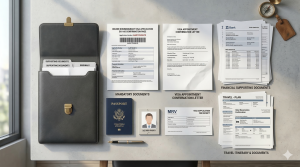
The B-1/B-2 visa is the principal U.S. nonimmigrant visitor visa for temporary business and tourism. B-1 covers specified business activities that do not constitute employment, while B-2 covers tourism, family visits, certain medical treatment and other temporary activities. Because many travelers may have both qualifying purposes, the Department of State commonly issues a combined B-1/B-2 visa.
Last reviewed: July 30, 2026.
A visitor visa is not permission to live, work or complete an academic program in the United States. It allows the holder to travel to a port of entry and request admission. Customs and Border Protection makes the final decision about entry and the authorized stay on each trip.
This guide explains the complete visitor framework and directs applicants to the specialized pages for eligibility, application steps, documents, interviews, refusals, status checks and extensions.
- B-1, B-2 and the Combined B-1/B-2 Visa
- Who Needs a B-1/B-2 Visa?
- Activities Permitted on B-1
- Activities Permitted on B-2
- Activities Not Permitted on a Visitor Visa
- B-1/B-2 Visa Eligibility Requirements
- B-1/B-2 Visa Application Overview
- Documents for a B-1/B-2 Application
- The Visitor Visa Interview
- Approval, Section 214(b) and Section 221(g)
- Visa Validity, Number of Entries and Reciprocity
- Admission, CBP and Form I-94
- Extending or Changing B Status
- Renewing a B-1/B-2 Visa
- Frequent or Long Visitor Trips
- Current 2026 Policies That Can Affect B Visas
- Related Tourist Visa Guides
B-1, B-2 and the Combined B-1/B-2 Visa
| Classification | Main Temporary Purposes | Important Restriction |
|---|---|---|
| B-1 | Business meetings, conferences, negotiations, consultations and other narrowly permitted business activity. | Does not provide general U.S. employment authorization. |
| B-2 | Tourism, vacation, visits with family or friends, certain medical treatment and short recreational courses without academic credit. | Does not permit degree study, ordinary employment or permanent residence. |
| B-1/B-2 | A combined visa usable for qualifying activities in both classifications. | The activity performed during each admission must remain permitted under visitor status. |
The visa annotation does not authorize every activity that could be described as “business.” A person performing productive labor, filling a U.S. position or receiving compensation for services may need a work-authorized classification even when the trip is short.
Who Needs a B-1/B-2 Visa?
Most foreign nationals require a visitor visa for temporary tourism or business unless an exception applies. Citizens of Canada and Bermuda generally do not need a visa for ordinary visitor travel, although classification and admissibility rules still apply.
Eligible citizens and nationals of Visa Waiver Program countries may use ESTA for qualifying trips of 90 days or less. A traveler may still need a B visa when:
- the passport is not from a Visa Waiver Program country;
- the planned stay exceeds 90 days;
- the traveler is ineligible for ESTA because of nationality, dual nationality, travel history or another statutory restriction;
- ESTA was denied or revoked;
- the trip uses a private aircraft or nonparticipating carrier; or
- the traveler prefers to apply for a visitor visa and can establish eligibility.
ESTA is not automatically “better” than a visa. It is faster and simpler for eligible short trips, but it provides limited options after admission. The complete comparison appears in the ESTA guide.
Activities Permitted on B-1
Permitted B-1 activity can include attending meetings and conferences, negotiating contracts, consulting with business associates, settling an estate and participating in certain professional activities conducted principally on behalf of a foreign enterprise.
The controlling issue is not merely where payment comes from. The officer may examine what services will be performed, whether the activity is productive work in the U.S. labor market, which entity benefits and whether another nonimmigrant classification specifically covers the activity.
Examples requiring careful analysis include training, installation or servicing under a commercial contract, board activity, speaking engagements, independent research, domestic employees accompanying an employer and maritime work requiring special annotations. Applicants should describe the real activity rather than selecting B-1 because it appears faster than a work visa.
Activities Permitted on B-2
B-2 generally covers tourism, vacations, visiting relatives or friends, medical treatment, participation in unpaid amateur events and short recreational study that is not for credit.
A person seeking medical treatment should be prepared to identify the U.S. provider, expected duration and arrangements for paying treatment and living costs. Supporting documentation for a medical-treatment B-2 case commonly includes a letter from a doctor in the home country describing the diagnosis and reason treatment is being sought in the United States, a letter from the U.S. medical facility or physician confirming willingness to provide treatment, evidence of the applicant’s ability to pay for treatment and living expenses during the stay, and a realistic estimate of how long treatment is expected to take. The Department of State prohibits birth tourism when the primary purpose is giving birth in the United States to obtain citizenship for the child.
Activities Not Permitted on a Visitor Visa
- Ordinary employment or services for a U.S. employer
- Degree study or other credit-bearing academic study
- Paid professional performances
- Work as a foreign journalist or media representative
- Crewmember activity on a ship or aircraft
- Using repeated visits to reside in the United States
- Travel whose intended purpose is permanent residence
Remote work can create legal risk. Working for a U.S. employer or U.S. clients is not authorized. Even foreign-employer activity can undermine visitor status when the person’s principal purpose in the United States is continuing regular work rather than a temporary visit. A traveler who must work from the United States should obtain individualized advice.
B-1/B-2 Visa Eligibility Requirements
A visitor applicant must establish a permitted temporary purpose, ability to pay for the trip, intent to depart and eligibility under the immigration laws. Section 214(b) presumes most nonimmigrant applicants are immigrants until they establish entitlement to the requested classification.
The officer evaluates each case individually. Relevant factors can include employment or business responsibilities, education, family relationships, finances, property, prior travel and the plausibility of the proposed trip. No single tie is mandatory, and no bank balance or invitation letter guarantees approval.
The dedicated U.S. tourist visa requirements guide explains Section 214(b), financial ability, permitted purposes and grounds of inadmissibility without duplicating the document checklist.
B-1/B-2 Visa Application Overview
- Confirm the category and processing post. The Department of State currently directs nonimmigrant applicants to apply in the country of nationality or residence, unless a designated post or limited exception applies.
- Complete Form DS-160. Enter accurate biographical, travel, work, education and security information and save the barcode confirmation.
- Create the local appointment account. Follow the embassy’s official link and select passport delivery.
- Pay the $185 MRV fee. The fee is nonrefundable and payment methods vary by post.
- Schedule biometrics and an interview. Some countries use separate service centers.
- Prepare the required and supporting documents.
- Attend the interview or follow the interview-waiver submission instructions.
- Follow the decision, CEAC and passport-delivery instructions.
The full operational detail belongs in the B-1/B-2 visa application process guide. Maintaining a separate process page allows this broad guide to remain useful without competing for every step-by-step query.
Documents for a B-1/B-2 Application
The baseline file generally includes a valid passport, DS-160 confirmation, appointment confirmation, fee receipt when required and a compliant printed photograph when the online upload failed. A post may request additional evidence of the trip’s purpose, the intent to depart and the ability to pay.
Supporting documents vary by applicant. Employment records may be useful for an employee, business records for an entrepreneur, enrollment records for a student and pension or property records for a retiree. A host’s invitation may explain accommodation or payment, but it is not required and does not replace the applicant’s own eligibility.
Use the complete tourist visa document checklist instead of relying on generic lists copied between countries.
The Visitor Visa Interview
The consular officer uses the DS-160, interview, government records and any relevant evidence to determine whether the applicant qualifies. Questions often concern the purpose, duration, funding, employment, family, travel history and reasons to return.
Applicants should answer truthfully and directly. The interview is not a performance, and memorized answers can create inconsistencies. The officer may decide the case without reviewing every paper.
Some renewals may qualify for an interview waiver. Under the guidance effective October 1, 2025, a person renewing a full-validity B visa within 12 months of expiration may be eligible when the prior visa was issued at age 18 or older, the application is made in the country of nationality or usual residence, no unresolved refusal exists and no apparent ineligibility is present. Eligibility does not prevent the officer from requiring an interview.
Prepare with the B-1/B-2 interview questions guide.
Approval, Section 214(b) and Section 221(g)
Approval and Issuance
After an approval indication, the passport normally remains with the post for printing. A visa should not be treated as issued until the passport is returned with the foil.
Section 214(b)
A 214(b) refusal means the applicant did not establish eligibility and/or did not overcome immigrant intent for that application. There is no formal appeal. Reapplication requires a new DS-160, fee and interview.
Section 221(g)
A 221(g) refusal can involve missing documents or administrative processing. The applicant should follow the written notice. CEAC may display “Refused” while the case remains capable of later issuance.
Other Ineligibilities
Fraud, unlawful presence, criminal history, prior removals and other grounds can require a waiver or prevent issuance. These cases should not be handled as ordinary 214(b) reapplications.
Use the visa denial guide to identify the legal section and next action.
Visa Validity, Number of Entries and Reciprocity
The visa’s validity and number of entries depend on the applicant’s nationality and the Department of State reciprocity schedule. Some applicants receive a multiple-entry visa valid for years; others receive a shorter or single-entry visa. An issuance or reciprocity fee may apply to particular nationalities.
A long-validity visa does not authorize a long stay. It only provides a period during which the traveler may present the visa for admission. The traveler must remain eligible and the visa must not have been canceled or revoked.
Admission, CBP and Form I-94
At an airport, land border or seaport, CBP reviews the passport, visa and purpose of travel. The officer can admit the traveler, limit the stay, refer the traveler for secondary inspection or deny admission.
The electronic I-94 normally controls the authorized stay. Many visitors receive up to six months, but no applicant is entitled to that period. CBP may grant less time based on the trip and circumstances.
Travelers should retrieve the I-94 after admission and correct errors promptly. A visa can remain valid after a person violates status, but an overstay may cause automatic visa voidance and other consequences.
Extending or Changing B Status
An eligible visitor may file Form I-539 with USCIS before the I-94 expires to request an extension or certain changes of status. The application must explain the temporary reason, financial support and continued intention to depart.
Filing does not guarantee approval. A pending request can affect travel, future visa applications and the calculation of authorized stay. Visa Waiver Program entrants generally cannot extend or change status, subject to narrow exceptions.
The B-1/B-2 extension guide explains the filing requirements and current USCIS fee verification.
Renewing a B-1/B-2 Visa
A renewal is a new visa application. The applicant completes a new DS-160, pays the current fee and follows the local scheduling procedure. Prior approval does not guarantee renewal.
Interview-waiver eligibility is narrower than it was under earlier temporary policies. Applicants should use the current embassy instructions rather than relying on an old “48-month dropbox” rule.
A valid visa in an expired passport may often be used with a new valid passport when the biographical information remains consistent and the visa has not been damaged, canceled or revoked. Do not remove the visa from the old passport.
Frequent or Long Visitor Trips
No published rule requires a visitor to remain outside the United States for a fixed number of days between trips. CBP evaluates whether each visit is genuinely temporary. A pattern of spending most of the year in the United States can appear to be unauthorized residence even when the traveler leaves before every I-94 date.
Visitors should be able to explain the trip, finances and continuing home outside the United States. Remote work, repeated extensions and immediate returns after long stays increase scrutiny.
Current 2026 Policies That Can Affect B Visas
Applicants should verify the latest Department of State news before filing. In 2026, changes included country-of-residence interview instructions, regional processing arrangements, enhanced screening, nationality-based visa suspensions, visa bond rules and a limited expedited appointment pilot at selected posts.
These policies can change faster than the underlying B visa requirements. The assigned embassy website and official Visa News page take priority over a static article.
Related Tourist Visa Guides
- Tourist Visa Guide Center
- U.S. Tourist Visa Requirements
- B-1/B-2 Application Process
- B-1/B-2 Document Checklist
- B-1/B-2 Interview Questions
- Visa Appointment Wait Times
- CEAC Visa Status Check
- ESTA and Visa Waiver Program
The B-1/B-2 visa works best when it is used for what it was designed to do: support a genuine temporary business or personal visit. The visa category, DS-160, interview answers, entry explanation and actual conduct in the United States should all remain consistent with that limited purpose.