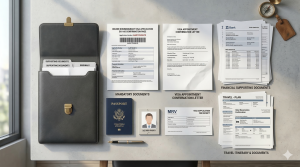
Applying for a U.S. visitor visa involves more than submitting Form DS-160. A complete B-1/B-2 visa application process includes selecting the correct visitor classification, choosing the proper U.S. embassy or consulate, completing the online application accurately, paying the nonrefundable government fee, scheduling the appropriate appointment, attending biometrics and an interview when required, and following the instructions issued after the consular decision.
Last reviewed: July 30, 2026.
The order of some steps varies by country because each embassy or consulate uses local payment, appointment and passport-delivery procedures. The legal standard, however, remains consistent: the applicant must qualify for the requested visitor classification and, under Immigration and Nationality Act Section 214(b), overcome the presumption of immigrant intent that applies to B visa applicants.
Current 2026 rule: The Department of State instructed nonimmigrant visa applicants in July 2026 to schedule interviews in their country of nationality or residence, unless a designated processing post or limited exception applies. An applicant relying on residence must be prepared to demonstrate lawful residence in that country.
- Step 1: Confirm That B-1, B-2 or B-1/B-2 Is the Correct Category
- Step 2: Choose the Correct Embassy or Consulate
- Step 3: Complete Form DS-160
- Step 4: Create the Appointment Account and Pay the MRV Fee
- Step 5: Schedule Biometrics and the Visa Interview
- Step 6: Prepare the Required Documents
- Step 7: Attend Biometrics and the Consular Interview
- Step 8: Understand the Possible Decisions
- Step 9: Check CEAC and Track the Passport
- Step 10: Travel to the United States and Check the I-94
- Common B-1/B-2 Application Mistakes
- Related B-1/B-2 Guides
Step 1: Confirm That B-1, B-2 or B-1/B-2 Is the Correct Category
The first decision is not the interview location or the document folder. It is whether the intended activity is permitted under a visitor classification.
- B-1 covers specified temporary business activities, such as attending meetings or conferences, negotiating contracts, consulting with business associates and completing other activities that do not constitute ordinary employment in the United States. See our B-1 visa supporting documents checklist for the full list of evidence to prepare.
- B-2 covers tourism, vacation, visits with family or friends, certain medical treatment, participation in unpaid amateur events and short recreational courses that do not provide academic credit.
- B-1/B-2 is the combined visitor visa commonly issued to applicants whose travel may include qualifying business and tourism activities.
A visitor visa does not authorize ordinary employment, degree study, professional performances for pay, work as foreign media, crewmember activity or permanent residence. The Department of State visitor visa guidance specifically identifies these activities as requiring another category.
Travelers holding passports from Visa Waiver Program countries should first determine whether ESTA is appropriate. ESTA is a travel authorization rather than a visa
, generally limits qualifying visits to 90 days and provides fewer options to extend or change status. A traveler who is ineligible for ESTA, plans to remain longer than 90 days or needs a purpose outside the Visa Waiver Program must use the appropriate visa process.
Step 2: Choose the Correct Embassy or Consulate
The applicant should identify the U.S. embassy or consulate that will process the case before paying a fee. According to the Department of State’s July 15, 2026 instructions, nonimmigrant applicants should schedule interviews in their country of nationality or residence. Nationals of countries without routine visa operations must normally use the designated processing post unless they legally reside elsewhere.
Applying in a third country can create practical and legal difficulties.
A post may have limited appointment availability for nonresidents, the applicant may find it harder to demonstrate ties outside the United States, and the fee usually cannot be transferred between countries. The local embassy website controls the appointment portal, acceptable payment methods, document-delivery service and local security requirements.
Before continuing, confirm:
- the post processes B visas;
- the applicant qualifies to apply there based on nationality or residence;
- the passport-delivery method is accessible;
- the local payment receipt will remain valid long enough to schedule the appointment; and
- the post is not operating under a suspension, regional hub arrangement or nationality-specific restriction.
Step 3: Complete Form DS-160
Form DS-160 is the online nonimmigrant visa application. The Department of State explains that consular officers use the information in the DS-160 together with the interview to determine eligibility.
The form asks for identity and passport information, travel plans, prior U.S. travel, family information, work and education history, U.S. contacts, security-related answers and other background facts. Each applicant, including a child, generally requires a separate DS-160.
How to Avoid DS-160 Errors
See our full DS-160 form guide for a complete walkthrough and what to do if you find a mistake after submission.
- Copy names, passport numbers and dates directly from official records.
- Use accurate employment and education dates rather than estimates when records are available.
- Disclose prior refusals, overstays, arrests and immigration violations truthfully.
- Keep the Application ID and security-question answer in a secure place.
- Save the form frequently and review every section before electronic submission.
- Confirm that the DS-160 location is consistent with the post where the interview will occur, following local instructions when a transfer is needed.
The applicant uploads a compliant photograph during the DS-160 process. When the upload fails or the post requires a printed photograph, the applicant must bring a photo meeting the current Department of State specifications.
After submission, print or save the barcode confirmation page. The entire DS-160 does not need to be printed, but keeping a personal copy of the answers can help the applicant prepare for the interview and maintain consistency in future applications.
Step 4: Create the Appointment Account and Pay the MRV Fee
After submitting the DS-160, the applicant normally creates an account in the appointment system linked by the U.S. embassy or consulate. The system is used to enter applicant information, select passport delivery, pay the fee and schedule appointments.
The B visa application processing fee is $185. The Department of State fee schedule classifies B visas as non-petition-based nonimmigrant visas. The fee is an application-processing fee and is not refunded when the visa is refused.
Payment methods vary by country and may include bank transfer, cash deposit or an approved online method. Use only the official appointment website linked by the embassy. Private companies cannot guarantee appointments or approval.
Do not pay twice because the website does not update immediately. Local systems may need time to recognize the payment. Follow the post’s instructions before attempting another transaction.
Step 5: Schedule Biometrics and the Visa Interview
Once the payment is activated, the applicant selects the required appointment or appointments. Some countries separate biometric collection at a Visa Application Center, Applicant Service Center, CAS or VAC from the consular interview. Other posts collect fingerprints on interview day.
The Global Visa Wait Times page is updated monthly and reports both historical average waits and the estimated time until the next visitor visa appointment. These estimates do not guarantee a specific appointment date. Embassies regularly release additional slots, so applicants may be able to reschedule to an earlier opening through the official system.
Expedited Appointments
Standard emergency procedures vary by post and usually require a normal appointment before an expedited request can be submitted. In addition, the Department of State announced a limited 2026 pilot at selected posts under which eligible B visa applicants may pay an additional $750 for an appointment within 10 business days, subject to availability. The pilot runs through December 31, 2026 and does not guarantee visa issuance.
Interview Waiver for Renewals
Under the Department of State guidance effective October 1, 2025, certain applicants renewing a full-validity B-1, B-2 or B-1/B-2 visa within 12 months of expiration may be eligible for an interview waiver when the prior visa was issued when the applicant was at least 18, the application is made in the country of nationality or usual residence, no unresolved refusal exists and no apparent ineligibility is present. A consular officer may still require an interview.
The appointment system, not the applicant, determines the local submission pathway. Applicants should not mail passports or documents unless instructed to do so.
Step 6: Prepare the Required Documents
The baseline file usually includes the passport, DS-160 confirmation, appointment confirmation, fee receipt when required and a printed photograph when the online upload did not succeed. Supporting evidence may be requested to establish the temporary purpose of travel, intent to depart and ability to pay.
The correct document package depends on the person’s circumstances. An employed traveler, business owner, student, retiree and medical patient will not rely on identical evidence. A large random stack is less useful than a concise, internally consistent file tied to the legal questions the officer must decide.
Use the separate B-1/B-2 document checklist for the full breakdown. That page should remain the definitive document resource so this application-process guide does not compete for the same search intent.
Step 7: Attend Biometrics and the Consular Interview
Arrive according to the time and security instructions published by the post. Electronic devices, large bags and sealed packages are often prohibited. Fingerprints and a digital photograph may be collected before the applicant meets the consular officer.
The officer evaluates the DS-160, security and immigration records, interview answers and any evidence considered necessary. B visa applicants must establish both eligibility for the visitor classification and compliance with Section 214(b).
Common Interview Topics
- The specific purpose and length of the trip
- Who will pay the expenses
- Employment, business, study or retirement circumstances
- Family in the United States and outside the United States
- Prior travel and immigration compliance
- The reason the applicant will return after the visit
- Any prior refusal, overstay, arrest or removal history
Answers should be truthful, direct and consistent with the DS-160. Memorized speeches and exaggerated claims can reduce credibility. A consular officer is not required to review every supporting document, and approval cannot be guaranteed by carrying a particular letter, property deed or bank balance.
Step 8: Understand the Possible Decisions
Approved
An oral indication of approval is encouraging, but the visa is not available for travel until it is printed in the passport and returned. Additional technical or security review can still occur before final issuance.
Refused Under Section 214(b)
A 214(b) refusal means the applicant did not sufficiently establish eligibility for the requested nonimmigrant category and/or did not overcome the presumption of immigrant intent. The refusal applies to that application. There is no formal appeal, although the person may submit a new DS-160, pay a new fee and reapply, preferably after correcting a material weakness or after circumstances have changed.
Refused Under Section 221(g)
A 221(g) refusal can mean the application is incomplete, a document is required or administrative processing remains pending. See our guide on administrative processing for what to expect and typical timelines. The applicant should follow the written instructions and submit only what the post requests through the specified method.
Another Ground of Inadmissibility
Criminal conduct, fraud or material misrepresentation, unlawful presence, prior removals and other statutory grounds can affect eligibility. Some grounds permit a discretionary nonimmigrant waiver; others may not. A person with a complex history should obtain individualized legal advice before reapplying.
Step 9: Check CEAC and Track the Passport
The CEAC Visa Status Check may display statuses such as Application Received, Ready, Issued or Refused. A public “Refused” status may represent a final refusal or a case remaining under 221(g), so the written consular notice controls the next action.
After the status changes to Issued, passport printing, quality control and courier transfer can still require additional time. Passport tracking normally occurs through the local appointment or delivery system rather than CEAC itself.
Do not purchase a nonrefundable ticket based only on an interview statement or online status. Wait until the passport is physically returned and verify the name, passport number, visa class, expiration date, number of entries and annotations.
Step 10: Travel to the United States and Check the I-94
A visa permits travel to a U.S. port of entry and a request for admission. It does not guarantee entry. Customs and Border Protection determines whether the traveler is admitted, the classification and the authorized period of stay.
The visa expiration date determines when the visa may be presented for travel; it does not determine how long the person may remain after entry. The electronic I-94 generally shows the admission class and Admit Until Date. Travelers should retrieve and verify the record after arrival through the official CBP I-94 portal.
Depart before the I-94 date unless USCIS grants a timely extension or change of status. Frequent or lengthy visits can lead CBP to question whether the traveler is using visitor status as a substitute for residence.
Common B-1/B-2 Application Mistakes
- Choosing B status for employment, academic study or permanent residence
- Using inconsistent dates or facts across DS-160 applications
- Applying in a third country without understanding residence and fee restrictions
- Paying on an unofficial website
- Buying nonrefundable travel before visa issuance
- Submitting false employment, bank or invitation records
- Assuming an invitation letter guarantees approval
- Ignoring a prior refusal, overstay, arrest or removal
- Confusing visa validity with the authorized I-94 stay
- Failing to follow the local passport-delivery instructions
Related B-1/B-2 Guides
- B-1/B-2 Tourist and Business Visa Complete Guide
- B-1/B-2 Visa Eligibility Requirements
- Documents Required for a U.S. Tourist Visa
- B-1/B-2 Interview Questions and Answers
- U.S. Visa Appointment Wait Times
- CEAC Visa Status Check
- Extending B-1/B-2 Status with Form I-539
- What to Do After a U.S. Visa Refusal
The most reliable application is one in which the category, DS-160, interview answers and evidence all describe the same legitimate temporary trip. Applicants should verify the embassy’s current instructions immediately before payment and again before attending the appointment, because local procedures and national policies can change.