

The correct U.S. visa category depends primarily on the real purpose of the trip. Tourism and short business travel normally use B-1/B-2 or, for eligible travelers, ESTA. Academic students generally use F-1, exchange visitors use J-1, and temporary workers use a category such as H-1B, L-1, O-1, TN, E-2, H-2A, H-2B or R-1.
People seeking permanent residence generally need a family-based immigrant visa, an employment-based immigrant category, an investment-based EB-5 visa, a Diversity Visa or another qualifying immigrant pathway. A temporary visa does not automatically become a green card.
U.S. visa types are organized according to the activity a foreign national intends to perform in the United States. There is no universal visa that covers tourism, study, employment, investment and permanent immigration at the same time.
The correct category depends on the purpose and expected length of the trip, the applicant’s nationality, the need for a U.S. petitioner or sponsor, professional or educational qualifications, family relationships, immigration history and whether the person intends to remain temporarily or immigrate permanently.
Choosing the wrong category can result in refusal, delays, additional fees or allegations that the applicant misrepresented the intended activity. A B-1/B-2 visitor visa, for example, cannot replace an employment visa, while ESTA cannot be used for permanent immigration or ordinary academic study.
The official Department of State Directory of Visa Categories contains the complete government classification. This guide organizes the major options by practical purpose and connects each category with the detailed application guides available on this site.
Last reviewed: July 29, 2026
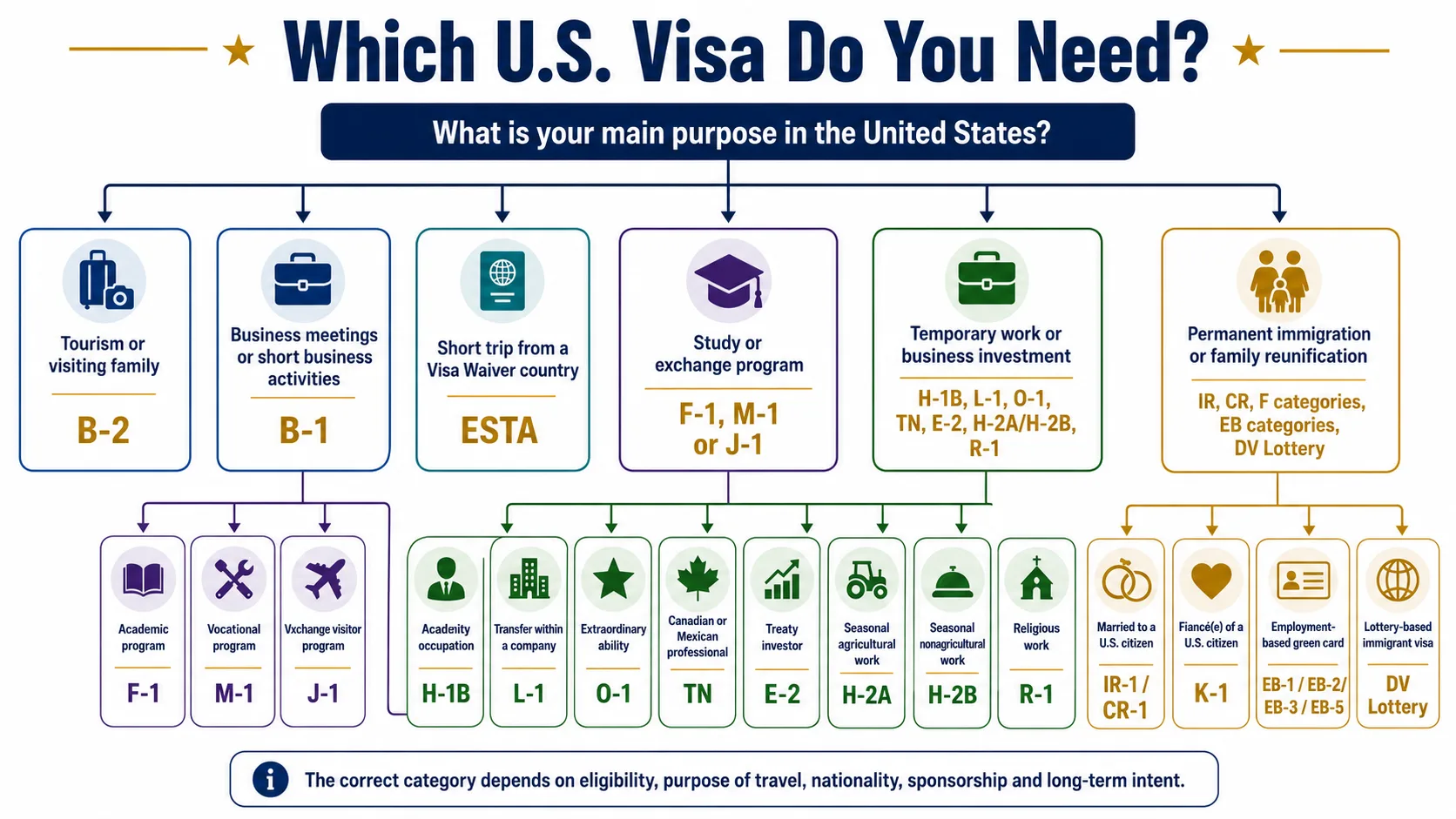
How U.S. Visa Types Are Classified
Most U.S. visas fall into two broad groups: nonimmigrant visas for temporary activities and immigrant visas for permanent residence.
| Classification | Purpose | Examples |
|---|---|---|
| Nonimmigrant visa | Temporary travel for a defined activity, such as tourism, study, exchange, employment, investment or official duty. | B-1/B-2, F-1, J-1, H-1B, L-1, O-1, TN, E-2, R-1, C and D. |
| Immigrant visa | Travel to the United States for admission as a lawful permanent resident. | IR-1, CR-1, F categories, EB-1 through EB-5, Diversity Visa and special immigrant categories. |
K-1 and K-3 visas are technically nonimmigrant classifications, but the Department of State groups them with immigration-related visas because their purpose involves marriage and potential permanent residence.
Humanitarian benefits such as asylum, refugee status, Temporary Protected Status, DACA, parole, U nonimmigrant status and T nonimmigrant status do not all follow the ordinary consular visa process. Some are applications filed directly with USCIS, while others involve the Department of State, immigration courts or additional federal agencies.
Visa, Immigration Status and Green Card Are Different
A visa is normally placed in a passport and allows a foreign national to travel to a U.S. port of entry and request admission in the listed category. It does not guarantee entry.
U.S. Customs and Border Protection determines whether the traveler may enter, the admission classification and the authorized period of stay. The electronic Form I-94 generally controls the authorized stay after entry, not the expiration date printed on the visa.
Immigration status describes the classification held while a person is physically present in the United States. A visa may expire while the person remains in valid status, or the person may violate status even though the visa stamp has not expired.
A green card represents lawful permanent resident status. Permanent residents may live and work indefinitely in the United States, subject to the laws governing maintenance and possible abandonment or loss of that status.
Visa: Allows the traveler to request admission for a particular purpose.
Status: Determines the person’s authorized classification and stay after admission or an approved change of status.
Green Card: Evidence of lawful permanent resident status.
ESTA: Travel authorization under the Visa Waiver Program, not a visa.
Tourist and Business Visa Types
B-1 Temporary Business Visitor
The B-1 classification covers certain temporary business activities that do not constitute ordinary employment in the United States. Permitted activities can include attending professional meetings, negotiating contracts, consulting with business associates, participating in conferences and completing other limited business functions authorized under the visitor rules.
B-1 status does not provide general authorization to perform productive labor for a U.S. employer or receive an ordinary U.S. salary for services performed in the country.
B-2 Tourist Visa
The B-2 category covers temporary tourism, vacations, visits with family or friends and certain medical-treatment trips. Many applicants receive a combined B-1/B-2 visa permitting both qualifying business and tourist activities.
The visa’s validity, permitted number of entries and possible reciprocity fee vary according to nationality and the applicable reciprocity schedule. The authorized stay after each entry is separately determined by CBP.
Review the complete B-1/B-2 visitor visa guide for eligibility, Form DS-160, fees, interviews, Section 214(b) refusals and admission rules.
ESTA and the Visa Waiver Program
Citizens or nationals of the countries participating in the Visa Waiver Program may be eligible to travel for tourism or qualifying business activities for up to 90 days without obtaining a B visa. They must first receive approval through the Electronic System for Travel Authorization.
As of July 2026, the official Visa Waiver Program list contains 42 participating countries and jurisdictions. Citizenship alone does not guarantee eligibility. Passport requirements, travel history, dual nationality, criminal or immigration issues and other statutory restrictions can prevent VWP travel.
ESTA approval does not authorize employment, ordinary academic study or permanent residence. Travelers admitted through the Visa Waiver Program also face significant restrictions on extending their stay or changing status from inside the United States.
Use the ESTA and Visa Waiver Program guide to review eligibility and application requirements.
Student and Exchange Visitor Visas
F-1 Academic Student Visa
The F-1 visa is used for full-time academic study at an eligible U.S. college, university, high school, conservatory, language program or other institution certified by the Student and Exchange Visitor Program.
The student must first be accepted by the institution and receive Form I-20. The student generally pays the SEVIS I-901 fee, completes Form DS-160 and applies for the visa through a U.S. embassy or consulate.
Employment is limited. Qualifying on-campus employment may be permitted, while most off-campus employment requires specific authorization. Eligible students may later qualify for Curricular Practical Training, Optional Practical Training or a STEM OPT extension.
Review the F-1 employment authorization guide for CPT, OPT, STEM OPT and work restrictions.
M-1 Vocational Student Visa
The M-1 category applies to vocational and nonacademic programs, such as certain technical, mechanical, culinary, aviation or occupational courses. The school must issue Form I-20, and the student must comply with SEVIS and enrollment requirements.
M-1 employment authorization is more restrictive than F-1 employment. Practical training is generally connected to completion of the vocational program and requires authorization.
J-1 Exchange Visitor Visa
The J-1 visa covers designated exchange programs for students, professors, research scholars, interns, trainees, teachers, au pairs, physicians, camp counselors and other approved participants.
The participant must receive Form DS-2019 from a designated program sponsor. Employment is permitted only as authorized by the exchange program and applicable rules.
Some J-1 participants become subject to the two-year foreign residence requirement under INA Section 212(e). When it applies, the person may be restricted from obtaining H, L or K status, an immigrant visa or adjustment of status until completing the requirement or receiving a waiver.
Review the J-1 Exchange Visitor guide for program categories, the two-year rule and waiver options.
Temporary U.S. Work Visa Types
Temporary work visas are connected to a specific classification, employer, petitioner, business, program or qualifying activity. A foreign national cannot simply obtain a general U.S. work visa and then accept any employment.
H-1B Specialty Occupation
The H-1B classification is used for specialty-occupation positions that normally require at least a bachelor’s degree or its equivalent in a directly related specialty. A U.S. employer generally files the petition after obtaining the required Labor Condition Application.
Many first-time private-sector petitions are subject to the annual cap and electronic registration process. Universities, affiliated nonprofit entities, nonprofit research organizations, government research organizations and certain other employers may qualify for cap-exempt treatment.
H-1B status is often approved in increments of up to three years, with a general six-year limit. Immigration law provides exceptions that can permit additional time for certain workers progressing through the employment-based permanent residence process.
Review the H-1B sponsorship and employment guide.
L-1 Intracompany Transferee
The L-1 classification allows a qualifying international organization to transfer certain employees from a related foreign office to a U.S. parent, branch, subsidiary or affiliate.
- L-1A: Executives and managers.
- L-1B: Employees with qualifying specialized knowledge.
L-1A can support a later EB-1C immigrant petition for a qualifying multinational manager or executive, but permanent residence requires a separate petition and eligibility determination.
Review the L-1 intracompany transferee guide.
O-1 Extraordinary Ability or Achievement
The O-1 category covers individuals who can establish extraordinary ability in sciences, education, business, athletics or the arts, or extraordinary achievement in motion picture or television production.
A U.S. employer or qualifying agent generally files the petition. The evidence can include major awards, published material, original contributions, critical roles, high compensation, judging, scholarly work, commercial success or comparable evidence permitted under the relevant standard.
O-1 approval does not automatically grant permanent residence. Some O-1 beneficiaries later pursue EB-1A or EB-2 National Interest Waiver classifications through separate immigrant petitions.
Review the O-1 extraordinary ability guide.
TN Professional Status
TN classification is available to qualifying Canadian and Mexican citizens working in professions listed under the United States-Mexico-Canada Agreement.
The applicant must possess the qualifications required for the listed profession and have qualifying prearranged professional activity. Canadian citizens often apply directly for TN admission at a port of entry, while Mexican citizens generally require a TN visa before seeking admission.
TN is a temporary classification and does not independently provide permanent residence. Immigration planning requires careful attention because TN does not recognize dual intent in the same manner as H-1B or L-1.
Review the TN visa guide for Canadian and Mexican professionals.
E-1 Treaty Trader and E-2 Treaty Investor
The E-1 visa is used by qualifying nationals of treaty countries who conduct substantial trade principally between the United States and the treaty country.
The E-2 visa allows qualifying treaty-country nationals to direct and develop a U.S. enterprise in which they have invested, or are actively investing, a substantial amount of capital. Certain essential, managerial or executive employees sharing the required treaty nationality may also qualify.
E status can be renewed while the treaty enterprise and applicant continue satisfying the requirements, but it does not directly create a green card. Permanent residence requires a separate immigrant pathway.
Review the E-2 Treaty Investor guide.
H-2A and H-2B Seasonal Workers
H-2A permits temporary or seasonal agricultural employment when the employer satisfies Department of Labor and USCIS requirements.
H-2B covers qualifying temporary nonagricultural work based on a one-time occurrence, seasonal need, peak-load need or intermittent need. H-2B is subject to numerical limits, although Congress and federal agencies may authorize supplemental allocations under particular conditions.
Both classifications are tied to the approved employer and temporary labor need. They do not independently grant permanent residence.
R-1 Religious Worker
R-1 classification is available to qualifying ministers and religious workers who will perform authorized religious duties for an eligible nonprofit religious organization or affiliated organization in the United States.
The U.S. religious organization files Form I-129 and must establish its eligibility, the religious nature of the position and the worker’s qualifying religious membership.
Review the R-1 religious worker guide.
Other Temporary Visa Categories
| Category | Main Purpose |
|---|---|
| C | Immediate and continuous transit through the United States. |
| D or C-1/D | Crewmembers serving aboard qualifying commercial ships or aircraft. |
| I | Representatives of foreign media performing qualifying journalistic activity. |
| P | Certain athletes, entertainers, artists and essential support personnel. |
| Q | Participation in an approved international cultural exchange program. |
| A, G and NATO | Diplomatic, foreign government, international organization and NATO-related official travel. |
| U | Certain victims of qualifying criminal activity who assist law enforcement and meet the statutory requirements. |
| T | Certain victims of severe forms of human trafficking who meet the applicable requirements. |
Family and Fiancé Visa Types
K-1 Fiancé(e) Visa
The K-1 visa permits the foreign fiancé(e) of a U.S. citizen to travel to the United States to marry the petitioning citizen within 90 days after admission.
The process begins when the U.S. citizen files Form I-129F. After petition approval, consular processing and visa issuance, the couple must marry within the required period. The foreign spouse then files a separate adjustment-of-status application for permanent residence.
K-1 is not available to the fiancé(e) of a lawful permanent resident. The petitioner must be a U.S. citizen.
Review the K-1 fiancé(e) visa guide.
IR-1 and CR-1 Spouse Immigrant Visas
IR-1 and CR-1 visas allow a qualifying spouse of a U.S. citizen to immigrate as a permanent resident.
- CR-1: Conditional resident classification generally used when the qualifying marriage is less than two years old when permanent resident status begins.
- IR-1: Immediate relative classification generally used when the marriage is at least two years old when permanent resident status begins.
The case normally begins with Form I-130 and proceeds through the National Visa Center and a U.S. embassy or consulate when the beneficiary applies abroad.
Review the IR-1 and CR-1 spouse visa guide.
Immediate Relative Categories
Immediate relative immigrant categories include:
- Spouses of U.S. citizens.
- Unmarried children under 21 of U.S. citizens.
- Parents of U.S. citizens who are at least 21 years old.
These classifications are not subject to the annual numerical limits that apply to family-preference categories. Petition, NVC, consular or USCIS processing time still applies.
Family Preference Categories
| Category | Qualifying Relationship |
|---|---|
| F1 | Unmarried adult sons and daughters of U.S. citizens. |
| F2A | Spouses and unmarried children under 21 of lawful permanent residents. |
| F2B | Unmarried adult sons and daughters of lawful permanent residents. |
| F3 | Married sons and daughters of U.S. citizens. |
| F4 | Brothers and sisters of adult U.S. citizens. |
Family-preference categories are numerically limited and may involve substantial priority-date waits. The petitioner generally begins the process through Form I-130.
Employment-Based Immigrant Visa Types
Employment-based immigrant classifications allow eligible workers, professionals, investors and special immigrants to obtain permanent residence. Many categories are subject to annual and per-country numerical limits.
EB-1 Priority Workers
- EB-1A: Individuals of extraordinary ability who may self-petition.
- EB-1B: Outstanding professors and researchers with a qualifying employer.
- EB-1C: Certain multinational managers and executives.
EB-1 does not require PERM labor certification, although each subcategory has separate evidentiary and petition requirements.
EB-2 Advanced Degree, Exceptional Ability and NIW
EB-2 covers qualifying professionals with advanced degrees and people of exceptional ability. Many employer-sponsored EB-2 cases require a permanent job offer and labor certification.
The National Interest Waiver can eliminate the job-offer and labor-certification requirements when the applicant establishes that the proposed endeavor has substantial merit and national importance, the applicant is well positioned to advance it, and waiving the normal requirements would benefit the United States.
Review the EB-2 National Interest Waiver guide.
EB-3 Skilled Workers, Professionals and Other Workers
EB-3 covers qualifying professionals, skilled workers and certain other workers. Most cases require a permanent full-time job offer, Department of Labor certification and an employer-filed Form I-140.
Visa Bulletin backlogs differ by subcategory and country of chargeability.
EB-4 Special Immigrants
EB-4 includes several specialized classifications, such as certain religious workers, Special Immigrant Juveniles, qualifying broadcasters, certain employees of international organizations and specified people who worked for or assisted the U.S. government.
EB-5 Immigrant Investors
EB-5 provides permanent residence to qualifying investors who place the required capital into a qualifying new commercial enterprise and satisfy the job-creation and lawful-source-of-funds requirements.
The program includes unreserved visas and reserved categories for qualifying rural projects, high-unemployment areas and infrastructure projects. Visa availability and processing rules can differ significantly between these categories.
Review the EB-5 immigrant investor guide.
Diversity Visa Lottery
The Diversity Visa Program makes a limited number of immigrant visas available each fiscal year to eligible applicants from countries with historically lower levels of immigration to the United States.
Submitting an electronic entry is not the same as obtaining a visa. Selection only permits the entrant to pursue the remaining process. The principal applicant must satisfy the education or qualifying work-experience requirement, complete the required forms, provide supporting evidence, become eligible under the applicable regional rank-number cutoff and receive the visa before the fiscal-year deadline.
The initial entry is submitted through the official Department of State system. The government does not charge a fee to submit the basic lottery entry.
Review the Diversity Visa Lottery guide.

Which Visa Types Can Lead to a Green Card?
Immigrant visas directly support admission as a lawful permanent resident. Nonimmigrant visas generally do not.
Some temporary classifications are compatible with a later immigrant petition:
- An H-1B worker may later become the beneficiary of an EB-1, EB-2 or EB-3 immigrant petition.
- An L-1A manager or executive may later qualify for EB-1C.
- An O-1 beneficiary may separately qualify for EB-1A or EB-2 NIW.
- An F-1 student may later change to an employment-authorized category and pursue an immigrant petition.
- An E-2 investor may separately qualify through EB-5, family sponsorship or another immigrant category.
- A K-1 entrant may apply for adjustment of status after marrying the petitioning U.S. citizen.
These are separate legal processes. Holding the temporary classification does not automatically create eligibility for the immigrant category.
Adjustment of Status vs. Immigrant Visa Processing
A person pursuing permanent residence generally completes one of two procedures.
| Procedure | Where It Occurs | Main Agency |
|---|---|---|
| Adjustment of status | Inside the United States when the applicant independently qualifies. | USCIS through Form I-485. |
| Consular processing | Through a U.S. embassy or consulate, normally for an applicant living abroad. | USCIS, NVC and the Department of State. |
Physical presence inside the country does not automatically create adjustment eligibility. Manner of entry, current status, unauthorized employment, adjustment bars, visa availability and grounds of inadmissibility can affect the analysis.
Review the Form I-485 adjustment-of-status guide or the consular processing guide.
How to Choose the Correct U.S. Visa Type
- Define the real purpose. Tourism, study, employment, investment and permanent immigration require different categories.
- Determine whether the stay is temporary or permanent. Temporary intent remains important for many nonimmigrant categories.
- Identify any required petitioner. Many work and family cases require a U.S. employer, citizen, permanent resident, school or program sponsor.
- Check nationality requirements. ESTA, TN and E classifications depend heavily on nationality.
- Review professional or educational qualifications. Degree, occupation, experience, extraordinary ability and program requirements vary substantially.
- Check current visa availability. Family-preference and employment-based immigrant categories may be controlled by the Visa Bulletin.
- Review immigration history. Overstays, unlawful presence, unauthorized employment, prior refusals, removal orders and misrepresentation can affect eligibility.
- Confirm the current government procedure. Forms, fees, interview rules, country restrictions and consular operations can change.
The U.S. visa and immigration application process guide explains how the major agencies, forms and procedural stages fit together.
Nationality-Specific Rules and Restrictions
Eligibility for a visa classification does not guarantee that the Department of State may issue the visa to every nationality at all times. Presidential proclamations, statutory restrictions, security policies, reciprocity rules, designated processing posts and country-specific suspensions can affect eligibility or processing.
Before filing or paying a fee, applicants should verify:
- The current Department of State visa news and restriction notices.
- The website of the embassy or consulate handling the application.
- The official reciprocity schedule for the applicant’s nationality.
- Whether the applicant should apply in the country of nationality or residence.
- Whether an exception or waiver applies to a current restriction.
Applicants should not assume that eligibility based on occupation, family relationship or school admission overrides a nationality-based visa restriction.
U.S. Visa Guides by Country
Nationality affects ESTA eligibility, reciprocity, visa validity, issuance fees, interview location, local document requirements and current government restrictions. The following guides provide country-specific starting points:
- U.S. visas for Mexican citizens
- U.S. visas for Brazilian citizens
- U.S. visas and ESTA for UK citizens
- U.S. visas and ESTA for French citizens
- U.S. visas and ESTA for German citizens
- U.S. visas and ESTA for Spanish citizens
- U.S. visas and ESTA for Italian citizens
- U.S. visas and ESTA for Japanese citizens
- U.S. visas and ESTA for South Korean citizens
- U.S. visas and ESTA for Australian citizens
A country guide cannot replace the current instructions issued by the U.S. embassy, Department of State, USCIS or CBP.
Visa Application Fees and Processing Times
Government fees depend on whether the category is petition-based, non-petition-based, an immigrant visa, an ESTA authorization or a USCIS application.
The standard Department of State application fee is currently $185 for many non-petition-based visas, including B, F, J, M and TN. Petition-based H, L, O, P, Q and R visa applications generally use a $205 fee. E visas and K visas use different amounts.
USCIS petition fees, SEVIS fees, NVC fees, immigrant visa fees, medical examinations, translations, reciprocity fees and the USCIS immigrant fee may apply separately.
Review the complete U.S. visa and immigration fee guide before making a payment.
There is no universal processing time for all visa types. Total waiting time can include:
- USCIS petition adjudication.
- Labor certification or electronic registration.
- Visa Bulletin waiting periods.
- National Visa Center document review.
- Embassy interview availability.
- Administrative processing.
- Passport printing and delivery.
Check the current U.S. visa appointment wait-time guide for consular availability.
Frequently Asked Questions About U.S. Visa Types
What U.S. visa is used for tourism?
Most temporary tourists use a B-2 or combined B-1/B-2 visitor visa. Eligible citizens of Visa Waiver Program countries may use ESTA for qualifying trips of 90 days or less.
Which visa allows employment in the United States?
There is no single unrestricted work visa. Employment must be authorized under a specific classification, such as H-1B, L-1, O-1, TN, E, H-2A, H-2B, R-1, P or another applicable category.
Can someone work with a B-1/B-2 visa or ESTA?
Neither B-1/B-2 nor ESTA provides general authorization to accept ordinary employment in the United States. B-1 permits only specified temporary business activities that do not constitute unauthorized labor.
Which visa is used for studying in the United States?
F-1 is generally used for academic study, M-1 for vocational study and J-1 for qualifying exchange programs. Each requires documentation from an approved school or designated program sponsor.
Does a work visa automatically lead to a green card?
No. A temporary work visa and an employment-based immigrant petition are separate benefits. Some workers later qualify for EB-1, EB-2, EB-3 or another category, but they must complete the separate permanent residence process.
What is the difference between ESTA and a visa?
ESTA is an electronic travel authorization available only to eligible Visa Waiver Program travelers. It is not a visa and generally permits qualifying tourism or business travel for no more than 90 days.
Does an approved visa guarantee entry?
No. A visa permits the traveler to request admission at a port of entry. CBP makes the final decision about admission, classification and authorized stay.
Which visa is used to marry a U.S. citizen?
A foreign fiancé(e) may use K-1 when the couple intends to marry in the United States within 90 days after admission. A couple that is already married generally considers an IR-1 or CR-1 immigrant visa or adjustment of status when independently eligible.
Related U.S. Visa and Immigration Guides
- Complete U.S. visa and immigration application process
- U.S. visa and immigration fees
- U.S. visa appointment wait times
- CEAC visa status check
- Form I-130 family petition
- Form I-485 adjustment of status
- NVC and immigrant visa processing
- Visa Bulletin and priority dates
- Green Card categories and requirements
Review notice: This page was fully updated on July 29, 2026 using current information from the U.S. Department of State, USCIS and U.S. Customs and Border Protection. Visa classifications, fees, nationality restrictions, admission rules and application procedures can change. Verify the official instructions for the selected category before submitting a form or paying a fee.
The correct U.S. immigration pathway begins with an accurate description of what the applicant intends to do. Select the category first, verify its nationality and sponsorship rules, review any prior immigration issues, and only then begin the petition, DS-160, DS-260, ESTA or adjustment-of-status process required for that classification.